Why Kovar Is Used in Hermetic Sealing
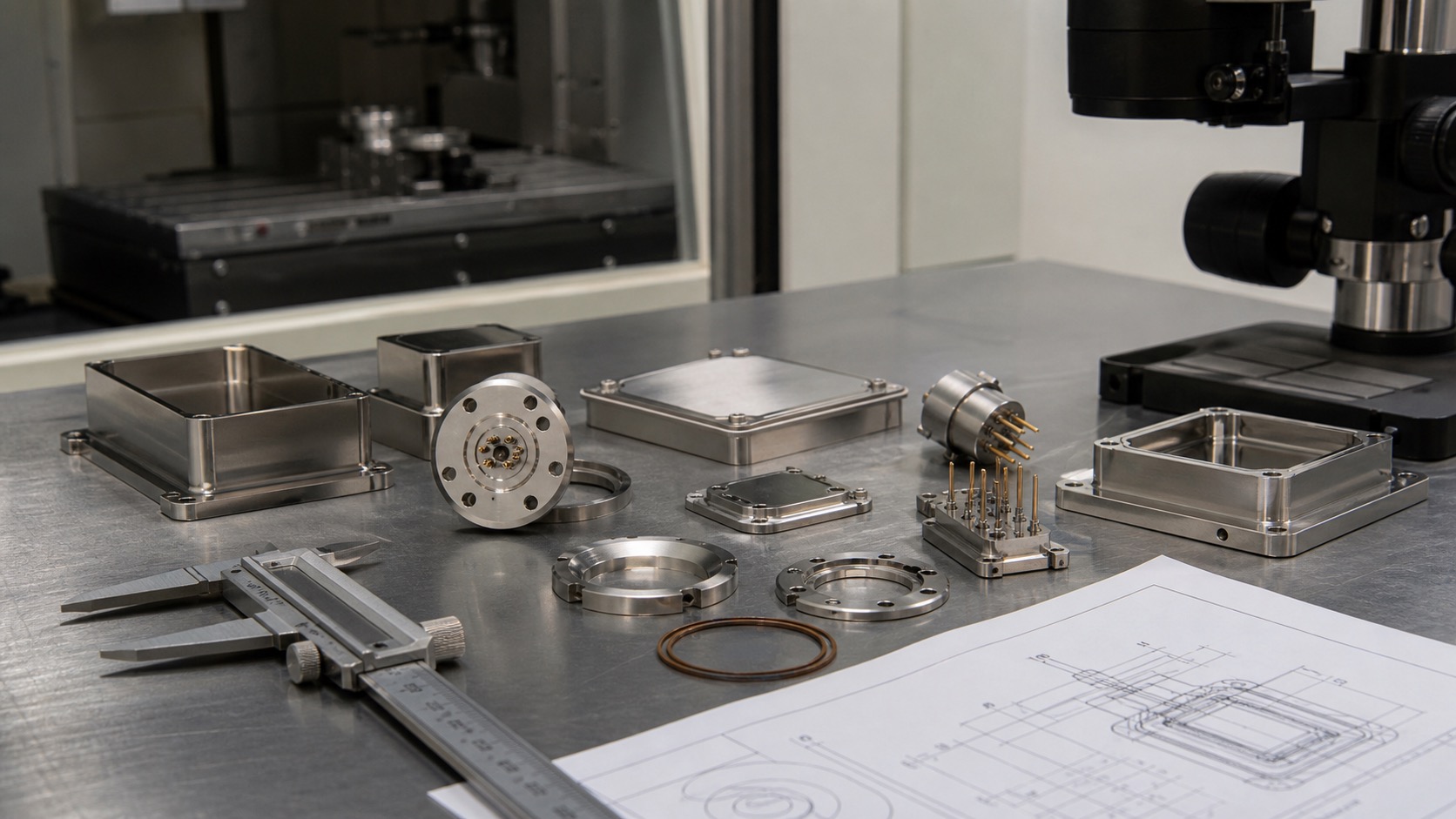
If you’ve ever designed a glass-to-metal seal for a mission-critical electronic package, you’ve likely crossed paths with Kovar. At KELTRYN, we machine Kovar components every day—housings, lids, flanges, and sealing rings—for customers who can’t afford a leak. In this article, I’ll walk through why Kovar has become the standard for hermetic sealing, how it compares to other alloys, and what you need to know to get reliable seals from your machined parts.
What Makes Kovar Ideal for Hermetic Sealing?
The single property that sets Kovar apart is its coefficient of thermal expansion (CTE). Kovar is engineered to closely match the CTE of borosilicate glass and many technical ceramics. Over a temperature range of roughly 30°C to 450°C, its expansion tracks that of borosilicate glass within a few parts per million per °C (ppm/°C). That match is critical: when you heat the assembly during sealing and then cool it, the metal and glass expand and contract together. Without this compatibility, stress fractures or delamination at the interface would be inevitable.
Kovar’s composition—typically 54% iron, 29% nickel, and 17% cobalt—is the reason. The cobalt addition fine-tunes the expansion curve and also plays a key role in the surface chemistry that makes sealing possible. During the glass-to-metal sealing process, Kovar is carefully pre-oxidized to form a thin, controlled oxide layer. That layer diffuses into the molten glass, creating a strong chemical bond. Too little oxide and the bond is weak; too much and the seal may become brittle. The alloy’s consistent oxidation behavior is why manufacturers and machine shops like ours can repeatably produce hermetic seals.
Hermetic Sealing Applications That Rely on Kovar
Kovar shows up wherever electronics must survive harsh environments—moisture, vacuum, thermal cycling, or corrosive gases. Some key industries include:
- Aerospace and defense: Feedthroughs for satellite communication modules, relay headers, and hermetically sealed connectors.
- Medical implants: Pacemaker housings and sensor packages that must remain leak-tight inside the body.
- Fiber optics: Laser diode housings and photodiode packages where moisture would degrade optical performance.
- Vacuum electronics: Microwave tubes, X-ray tubes, and particle accelerator components.
- Semiconductor equipment: Hermetic enclosures for sensitive MEMS and RF devices.
Common products made from Kovar include glass-to-metal feedthrough pins, transistor header bases, hermetic relay headers, and circular connector shells. The common thread: any leak—even a tiny one measured in std cc/s (standard cubic centimeters per second) of helium—can compromise performance or safety.
How Kovar Compares to Other Sealing Alloys
Kovar vs. Alloy 42
A frequent question we hear is, “What’s the difference between Kovar and Alloy 42?”
Alloy 42 (42% nickel, balance iron) has a lower CTE than Kovar. It’s often used for compression seals with softer glasses, or in applications where the expansion mismatch can be managed with design. Alloy 42 is also less expensive because it lacks cobalt.
When do you choose one over the other? If you’re sealing to borosilicate glass (Pyrex® or similar), Kovar is the proven match. Alloy 42 may work for certain soda-lime or lead glasses, but the seal reliability under thermal cycling is generally inferior. For cost-sensitive, lower-reliability applications, Alloy 42 can be a viable alternative. For hermetic seals that must pass MIL-STD-883 or similar tests, we always recommend Kovar.
Kovar vs. Invar
Another common comparison: “How is Kovar different from Invar?”
Invar (36% nickel, balance iron) is famous for extremely low thermal expansion near room temperature—it barely moves. That makes it ideal for precision components like optical mounts or measuring instruments. But Invar lacks cobalt, and its oxidation behavior is not optimized for glass sealing. You can’t simply seal Invar to borosilicate glass the same way you seal Kovar. If your design requires dimensional stability but not a hermetic glass seal, Invar might be the right choice. For a direct glass-to-metal seal, stay with Kovar.
The Glass-to-Metal Sealing Process with Kovar
Understanding the sealing process helps you appreciate why Kovar is so widely used. There are two main approaches: matched sealing and compression sealing.
Matched sealing (the most common with Kovar) uses a glass whose CTE closely matches the Kovar. The metal part is pre-oxidized in a controlled atmosphere, often a wet hydrogen or nitrogen/oxygen mixture, to produce a uniform oxide layer about 1–5 microns thick. The glass preform or bead is placed in contact with the Kovar, then heated to around 950°C–1050°C. The glass melts, wets the oxide, and forms a bond. After cooling, the stresses are minimal because expansions are matched.
Compression sealing uses a glass with a higher CTE than the metal, so after cooling the glass is under compressive stress. This can work with other alloys, but Kovar’s expansion can be tailored via composition to support certain compression designs. The pre-oxidation step is still critical.
After sealing, parts go through thermal cycling (e.g., -65°C to +150°C) and leak testing (usually helium mass spectrometry) to verify hermeticity below 1×10⁻⁹ std cc/s. At KELTRYN, we pay close attention to the sealing surfaces during machining—surface finish and burr control directly affect oxide formation and final seal quality.
Advanced Joining Techniques for Kovar Hermetic Seals
Laser Welding of Kovar
For applications where glass sealing isn’t possible—or where a secondary metal seam must be hermetic—laser welding is common. Kovar can be laser welded to itself or to other compatible alloys like stainless steel, but it presents challenges.
The main issue is oxidation. Kovar’s cobalt and nickel content means the weld pool can form oxides that create porosity or brittle phases. Best practices include:
- Using an inert cover gas (argon or helium) with low oxygen and moisture content.
- Pre-weld cleaning to remove oils, fingerprints, and oxide scale. A solvent degrease plus a light acid etch is typical.
- Joint design: lap joints with tight fits (0.05–0.10 mm gap) work better than butt joints, which are more prone to blowholes.
- Pulsed laser mode (e.g., Nd:YAG or fiber laser) for low heat input and reduced distortion; continuous-wave mode can be used for thicker sections but requires careful parameter control.
We often recommend a pre-weld vacuum bake at 400°C–500°C to drive off hydrogen from the material—this reduces porosity in the weld.
Resistance Seam Welding and Cladding
For high-volume hermetic packages (e.g., transistor bases), resistance seam welding is used to attach Kovar lids to Kovar frames. The challenge is maintaining consistent electrode contact and avoiding expulsion of molten metal. Proper electrode dressing and heat balance are essential.
Sometimes designers need to combine Kovar’s sealing properties with copper’s thermal conductivity. In those cases, we machine Kovar-clad copper or use metal injection molding (MIM) to create composite structures. KELTRYN has experience with both approaches, especially for RF and power modules where electrical and thermal performance are critical.
Common Challenges and How to Overcome Them
Working with Kovar is not trivial. Here are the typical pitfalls and how we address them:
- Oxidation control during welding: As noted, pre-weld baking in vacuum or hydrogen and using a low-dew-point cover gas (≤ -50°C dew point) prevents weld defects.
- Contamination: Oils from fingers or residual lubricants can ruin a seal. We use solvent degreasers and ultrasonic cleaning after machining, and we handle parts with cleanroom gloves during final inspection.
- Joint design: Lap joints are preferred for welding. For glass sealing, the sealing surface must be flat, free of burrs, and with a controlled surface roughness (typically 0.4–0.8 µm Ra). We inspect every sealing face with optical comparators or profilometers.
- Distortion: Thin-walled Kovar parts can warp during machining. We use stress-relief annealing (typically 900°C for 1 hour in argon) before final machining, and we design fixtures that support the part during cutting.
- Hydrogen outgassing: Kovar can absorb hydrogen during processing. A post-weld bake at 450°C in vacuum for 4–8 hours removes the hydrogen and improves seal integrity.
Frequently Asked Questions (FAQ)
What is Kovar used for?
Kovar is used primarily for hermetic glass-to-metal seals in electronic packages, vacuum tubes, semiconductor headers, laser diode housings, and any application requiring a leak-tight barrier between a metal package and glass or ceramic insulator.
What is the difference between Kovar and Alloy 42?
Kovar contains cobalt (≈17%) which gives it a higher CTE that matches borosilicate glass. Alloy 42 (42% Ni, balance Fe) has a lower CTE and no cobalt, making it cheaper but less compatible with standard sealing glasses. Alloy 42 is used for less demanding compression seals or as a lower-cost alternative where CTE mismatch can be managed.
What is Kovar equivalent to?
Common designations: ASTM F15, UNS K94610, F15-61, or MIL-I-23011/4. In Europe, it’s often called Dilver P or Vacon 10. The composition is consistently around 29% Ni, 17% Co, balance Fe (with minor trace elements).
What is the difference between Kovar and Invar?
Invar (36% Ni, balance Fe) has a very low CTE near room temperature, prized for dimensional stability. It does not contain cobalt and does not bond well to glass. Kovar’s CTE is higher and engineered to match borosilicate glass, enabling hermetic seals. Invar is used for precision mechanical components, not for glass sealing.
Conclusion
Kovar remains the go-to alloy for demanding hermetic sealing applications because of its unmatched thermal expansion match to borosilicate glass, its reliable oxide bonding chemistry, and the decades of process maturity behind it. Whether you’re designing a satellite feedthrough, a medical implant package, or a high-reliability sensor, Kovar gives you the best chance of achieving a leak-free seal that survives thermal cycling and environmental stress.
But working with Kovar requires expertise. From pre-oxidation control to thin-wall machining to contamination-free handling, small details determine success. At KELTRYN, we’ve built our precision CNC machining capabilities around these challenges. We machine custom Kovar housings, lids, sealing rings, flanges, and frames to tight tolerances, and we provide design-for-manufacturability feedback that saves our customers time and scrap.
If you have a Kovar component in development—prototype or production—I encourage you to reach out. Send us your drawing or CAD model. We’ll review the material requirements, sealing features, and tolerances, and give you a clear path to a reliable part.
Contact KELTRYN today to discuss your Kovar hermetic sealing project.
RFQ Support
Send Your Kovar Machining RFQ
Share drawings, CAD files, material requirements, quantities, tolerances, finishing needs, inspection requirements, and your target timeline. Our team will review the details and respond by email.
Helpful RFQ details
- 2D drawings or 3D CAD files
- Material: Kovar / ASTM F15 / Fe-Ni-Co alloy
- Quantity, tolerance, finish, inspection needs
- Application and purchasing timeline
Direct email: info@kovarmachining.com