What Is Kovar Alloy? Composition, Properties, Uses, and Comparisons
If you work with hermetic electronic packages, glass-to-metal seals, or high-reliability components that must survive thermal cycling, you’ve probably encountered the name Kovar. But what exactly is this material, and why is it so indispensable in industries ranging from aerospace to medical devices?
I’m a senior application engineer at KELTRYN, and over the years I’ve helped countless design and sourcing teams specify, machine, and qualify Kovar components for demanding applications. In this article, I’ll walk you through everything you need to know about Kovar alloy: its composition, properties, how it compares to alternatives like Alloy 42, and when it’s the right—and sometimes the only—choice.
---
Introduction to Kovar Alloy
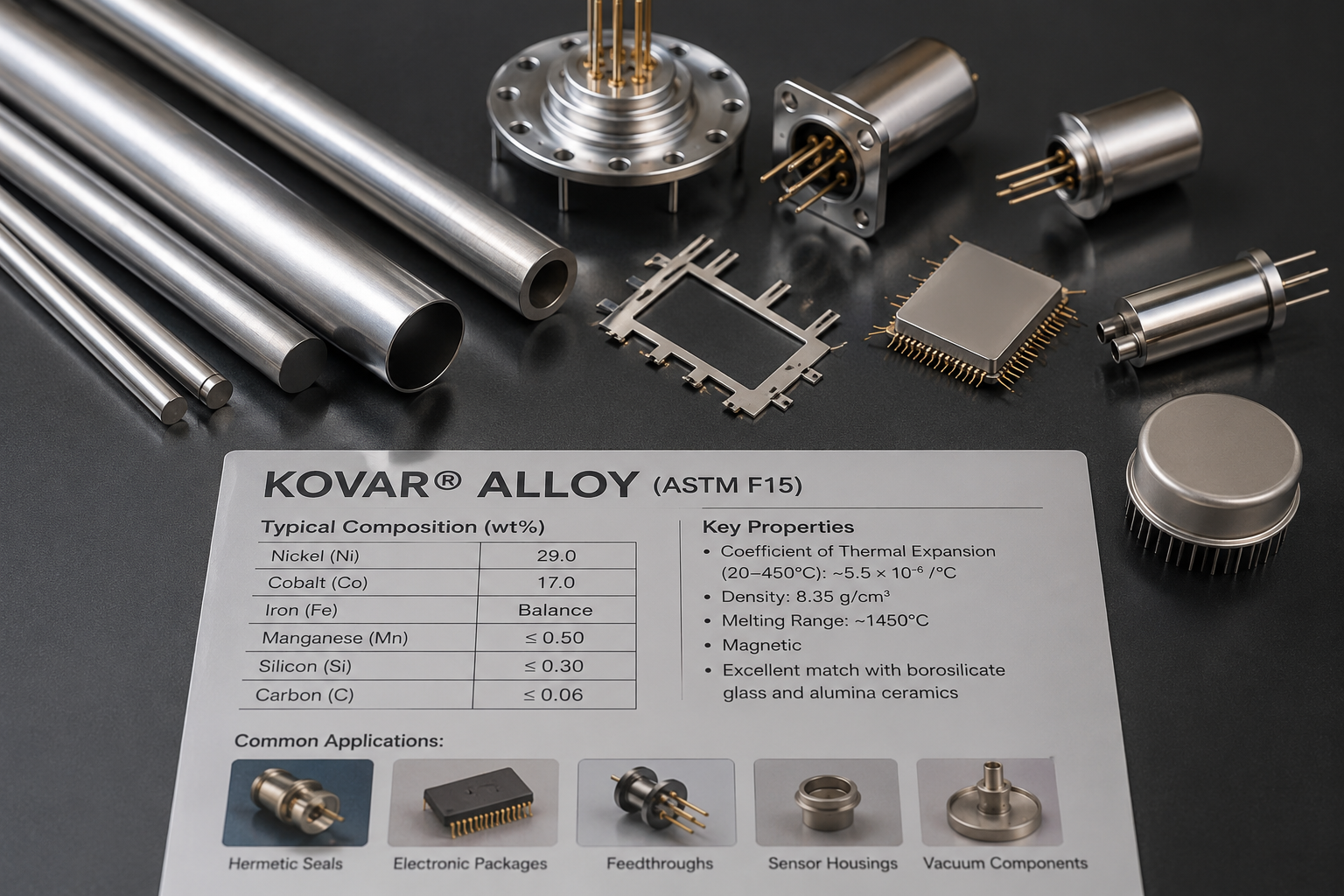
Kovar is a nickel‑iron‑cobalt controlled‑expansion alloy, officially designated as ASTM F15. Its defining characteristic is a coefficient of thermal expansion (CTE) that closely matches borosilicate glass and certain alumina ceramics from room temperature up to about 450°C. This match makes it the material of choice for creating hermetic, stress‑free seals between metal and glass or ceramic in electronic and vacuum devices.
The alloy is known by several trade names: Kovar® (the original brand, now owned by Carpenter Technology), Rodar, Nilo K (Special Metals), Pernifer 2918 (VDM Metals), and Dilvar P1. Whichever name appears on your print, the material behaves the same—chemically and physically.
Common applications include transistor headers, IC lead frames, power tube envelopes, X‑ray tube housings, pacemaker feedthroughs, laser diode packages, and microwave connectors. Whenever a package must remain vacuum‑tight or inert‑gas‑filled through temperature extremes, Kovar is often the answer.
---
Chemical Composition of Kovar
Typical Composition (ASTM F15)
The nominal composition per ASTM F15 is:
- Nickel (Ni): 29%
- Cobalt (Co): 17%
- Iron (Fe): Balance
- Manganese (Mn): ≤ 0.50%
- Silicon (Si): ≤ 0.30%
- Carbon (C): ≤ 0.06%
These percentages are tightly controlled. Even small deviations can shift the CTE curve and ruin the glass‑to‑metal seal integrity.
Why Cobalt Is Critical
Cobalt is what gives Kovar its low, stable CTE. In the Fe‑Ni‑Co system, a specific ratio of nickel and cobalt (roughly 29% Ni, 17% Co) creates an invar‑like effect—an anomalously low expansion over a broad temperature range. Without cobalt, a simple Fe‑Ni alloy would have a higher CTE or a narrower working range. That’s why Kovar contains no chromium and is not a stainless steel—cobalt, not chromium, is the key alloying element.
Impurity Limits and Standards
For consistent performance, ASTM F15 imposes strict limits on trace elements:
- Carbon must be kept low to avoid carbide precipitation, which can affect expansion.
- Sulfur and phosphorus are minimized to prevent hot shortness during forming.
- Manganese and silicon are added as deoxidizers and to improve machinability, but within narrow ranges.
At KELTRYN, we always request material certifications with full chemistry and CTE test data for every heat—especially for mission‑critical components.
---
Physical and Mechanical Properties
Coefficient of Thermal Expansion (CTE)
This is Kovar’s headline property. Typical CTE values:
- 20–450°C: ~5.5 × 10⁻⁶ /°C
- Matches borosilicate glass (e.g., Corning 7052, 7056) and 94–96% alumina ceramics.
Below room temperature, the CTE remains low and linear down to about –200°C. Above 500°C, the expansion curve begins to rise, so applications above that range require careful design.
Density, Melting Point, and Electrical Resistivity
- Density: 8.35 g/cm³ (slightly heavier than steel)
- Melting range: ~1450°C (solidus)
- Electrical resistivity: ~49 µΩ·cm (moderate, suitable for resistance heating during sealing)
Mechanical Properties (Annealed Condition)
In the annealed condition (typical for forming and machining), Kovar offers:
- Tensile strength: ~550 MPa
- Yield strength (0.2% offset): ~345 MPa
- Elongation: ~30% (good ductility)
It is ductile enough to be deep‑drawn or machined, but not as strong as high‑strength stainless steels. For applications requiring higher strength, cold‑worked Kovar or age‑hardened variants exist, but they come with a shift in CTE.
Magnetic Properties
Kovar is ferromagnetic at room temperature. This can be an advantage in some magnetic‑flux‑based sealing processes or a concern in applications sensitive to magnetic interference. If you need a non‑magnetic controlled‑expansion alloy, other Fe‑Ni alloys (like Alloy 48) or specialty materials are available.
---
Specifications and Equivalents
ASTM F15 and Other Standards
The most common specification is ASTM F15 (also known as UNS K94610). Others include:
- SAE AMS-I-23011 (inactive, but still referenced)
- MIL-I-23011C
- DIN 17745 (German standard)
Regardless of the standard, the chemistry and CTE requirements are essentially the same.
Commercial Equivalents (Answering PAA: “What is Kovar equivalent to?”)
Yes, Kovar has several fully interchangeable commercial brands. If your supplier offers Carpenter Kovar, Nilo K, Pernifer 2918, Rodar, or Dilvar P1, you can treat them as drop‑in replacements for ASTM F15. All are controlled‑expansion alloys with the same nominal composition and CTE.
At KELTRYN, we have machined parts from multiple suppliers and found consistent performance as long as the material certs match the spec.
Cross‑Reference Table (Optional)
For quick reference:
| Brand | Manufacturer | Standard |
|-------|--------------|----------|
| Kovar® | Carpenter Technology | ASTM F15 |
| Nilo K | Special Metals | ASTM F15 |
| Pernifer 2918 | VDM Metals | ASTM F15 |
| Rodar | (formerly) | ASTM F15 |
| Dilvar P1 | (various) | ASTM F15 |
---
Is Kovar Stainless Steel? (Answering PAA)
No. Kovar is not a stainless steel. The key difference: stainless steels contain at least 10.5% chromium, which forms a passive oxide layer for corrosion resistance. Kovar has zero chromium. Its composition is Fe‑Ni‑Co.
Because of this, Kovar can tarnish and corrode in humid or mildly corrosive environments. For hermetic seal applications, the inside of the package is usually dry or inert, but the external surfaces are often plated—typically with nickel, gold, or silver—to improve solderability and protect against corrosion.
If you need a material that combines controlled expansion with stainless‑like corrosion resistance, look at Stainless Invar or Alloy 902 (also called Invar 36 with a passivation treatment), but these are different materials with different CTE curves.
---
Kovar vs. Alloy 42 (Answering PAA)
This is one of the most common questions I hear: “Should I use Kovar or Alloy 42?” Let me break down the differences.
Composition Difference
- Kovar: 29% Ni, 17% Co, balance Fe
- Alloy 42: 42% Ni, no cobalt, balance Fe
Alloy 42 is a binary Fe‑Ni alloy, sometimes called “42 Alloy” or “N42.” It achieves its lower expansion through the nickel content alone.
CTE Comparison
- Alloy 42 CTE: ~4.9 × 10⁻⁶ /°C (20–400°C)
- Kovar CTE: ~5.5 × 10⁻⁶ /°C (20–450°C)
That 0.6 × 10⁻⁶ difference matters. Kovar is designed to match borosilicate glass (CTE ~5.5). Alloy 42 matches softer glasses (e.g., lime glass) and some lower‑expansion ceramics. If you use Alloy 42 with borosilicate glass, the mismatch can cause cracking or leaks during thermal cycling.
When to Use Which
- Choose Kovar for borosilicate glass seals, alumina ceramic seals, and applications requiring a CTE close to 5.5.
- Choose Alloy 42 when matching glass with a CTE around 4.9, or when cost is a higher priority and CTE tolerance is looser.
Cost Factor
Kovar is typically 20–50% more expensive than Alloy 42 because cobalt is costly and the processing controls are tighter. I’ve seen projects switch to Alloy 42 to save money, only to discover seal failures later—so choose carefully based on your glass/ceramic partner and temperature range.
---
Applications of Kovar Alloy
Kovar appears in a surprising number of high‑reliability devices. Here’s where we see it most often at KELTRYN:
Semiconductor & Electronic Packaging
- Transistor headers and bases
- IC lead frames for hermetic packages
- Hermetic enclosures for 5G RF filters and radar modules
Power & Microwave Tubes
- High‑power vacuum tubes (klystrons, magnetrons)
- X‑ray tube housings
- Microwave diode packages
Medical Devices & Implantables
- Pacemaker and defibrillator housings
- Implantable sensor feedthroughs
- Diagnostic instrument seals (CT scanners, blood analyzers)
Aerospace & Defense
- Connector shells and isolators
- Optical component housings (laser rangefinders)
- Satellite feedthroughs
Photonics & Optoelectronics
- Laser diode packages
- Fiber‑optic feedthroughs
- Detector windows for IR sensors
Vacuum Equipment & Sensors
- Flanges and viewports for high‑vacuum chambers
- Pressure sensor diaphragms
- Cryogenic instrument housings
---
Is Kovar Expensive? (Answering PAA)
Yes, Kovar is more expensive than standard engineering alloys like 304 stainless steel or low‑carbon steel. Here’s the typical reality:
- vs. 304 stainless: 3–5x more per pound
- vs. Alloy 42: 20–50% more
- vs. specialty superalloys: comparable or slightly less
The price reflects the cost of cobalt, the tight chemistry controls, and the specialized processing (vacuum induction melting, controlled annealing). But for high‑reliability applications—medical implants, aerospace electronics, X‑ray systems—the cost is justified. A single hermetic seal failure can cost orders of magnitude more than the material savings.
At KELTRYN, we often help customers evaluate whether Kovar is the right choice by reviewing their CTE requirements and seal process. Sometimes a lower‑cost alternative like Alloy 46 or a clad metal can work if the temperature range is narrow and the glass match is confirmed.
---
How Kovar Is Manufactured and Processed
Understanding how Kovar is made helps you appreciate why precision machining requires a partner who knows the material.
Melting and Forming
Kovar is typically vacuum induction melted (VIM) to control impurities. The ingot is then hot‑rolled into plate, rod, or bar. For wire, cold drawing is used. The material is delivered in the annealed condition unless otherwise specified.
Heat Treatment (Annealing)
Annealing at 850–1000°C in a hydrogen atmosphere (or vacuum) relieves internal stresses and develops the proper grain size for optimal expansion characteristics. Improper annealing can permanently shift the CTE curve.
Machining and Welding
Kovar is machinable but work‑hardens and forms stringy chips similar to pure nickel or stainless steel. At KELTRYN, we use sharp carbide tools, controlled speeds/feeds, and plenty of coolant to manage heat and burrs. For welding, we use matching‑composition filler (e.g., Kovar welding wire) and minimize heat input to avoid expansion mismatch in the heat‑affected zone.
Plating and Coating
Bare Kovar will tarnish. Most hermetic packages are plated:
- Nickel (electroless or electrolytic) – improves solderability
- Gold over nickel – for wire bonding and corrosion resistance
- Silver – for high‑temperature brazing
At KELTRYN, we often machine Kovar parts that are then plated by our partner plating houses. We also offer surface finish specifications critical for subsequent plating adhesion.
---
Frequently Asked Questions About Kovar Alloy
What is Kovar equivalent to?
As covered, trade names like Nilo K, Pernifer 2918, and Rodar are equivalent.
Is Kovar expensive?
Yes, but the cost is justified for applications requiring matched expansion and hermeticity.
Is Kovar a stainless steel?
No. It contains no chromium. It can corrode if uncoated.
What is the difference between Kovar and Alloy 42?
Kovar contains cobalt, has a higher CTE (~5.5 vs. 4.9), and matches borosilicate glass; Alloy 42 is cheaper and matches softer glasses.
Can Kovar be welded?
Yes, but use matching filler and low heat input to avoid CTE mismatch in the heat‑affected zone. Laser welding is common.
What temperature range is Kovar useful for?
Effectively –250°C to +450°C. Above 500°C the CTE curve rises, so it’s not recommended for continuous use above that.
Is Kovar magnetic?
Yes, it is ferromagnetic at room temperature.
Does Kovar rust?
It does not rust like steel (iron oxide), but it can tarnish and corrode in humid environments without a protective coating.
---
Conclusion
Kovar alloy occupies a unique and irreplaceable niche in precision engineering. Its precisely tailored coefficient of thermal expansion makes it the go‑to material for glass‑to‑metal and ceramic‑to‑metal seals in electronics, medical devices, aerospace, and photonics. While it’s not stainless steel, and it costs more than common alloys, the reliability it delivers in hermetic packaging is unmatched.
If you’re designing a component that requires controlled expansion—a custom housing, lid, ring, or flange—choosing the right supplier matters just as much as choosing the right alloy. At KELTRYN, we specialize in precision CNC machining of Kovar and Fe‑Ni‑Co alloys for hermetic and high‑reliability applications. We understand how to manage work hardening, burrs, thin‑wall tolerances, and sealing features that others struggle with.
Whether you need a single prototype or a production batch, we’re ready to help. Contact us with your drawing or model, and let’s discuss how we can turn your Kovar design into a machined part that performs exactly as required.
RFQ Support
Send Your Kovar Machining RFQ
Share drawings, CAD files, material requirements, quantities, tolerances, finishing needs, inspection requirements, and your target timeline. Our team will review the details and respond by email.
Helpful RFQ details
- 2D drawings or 3D CAD files
- Material: Kovar / ASTM F15 / Fe-Ni-Co alloy
- Quantity, tolerance, finish, inspection needs
- Application and purchasing timeline
Direct email: info@kovarmachining.com