The Complete ASTM F15 Material Guide: Composition, Properties, and Applications
When a design engineer hands me a drawing for a hermetic feedthrough or a glass-sealed housing, the first question is almost always the same: "What material should we use?" More often than not, the answer is ASTM F15. If you work in high-reliability electronics, aerospace, medical devices, or vacuum systems, you've probably seen this specification on a print or datasheet. But what exactly is it, and why does it dominate hermetic sealing applications?
I've spent years machining this alloy and helping customers get the most out of it, so let me walk you through the material in detail — its composition, physical and mechanical behavior, specifications, processing routes, and the practical sourcing considerations you need to know.
Introduction: What Is ASTM F15 Material?
ASTM F15 is the standard specification for a controlled-expansion nickel-iron-cobalt alloy. In plain language, it's a metal engineered to barely expand when heated over a specific temperature range — and that near-zero growth is exactly why it exists.
The material is designed for one primary job: forming permanent, reliable hermetic seals with borosilicate glasses and alumina ceramics. When you heat a metal and a glass together during the sealing process, they both expand. If they expand at different rates, the seal cracks or leaks. ASTM F15 was formulated so that its thermal expansion closely matches those sealing partners across the critical temperature window, allowing the glass and metal to lock together without destructive stress.
The alloy is commonly called Kovar, which is a trademarked brand name owned by Carpenter Technology. ASTM F15 is the governing specification that defines the chemistry and performance requirements. Many suppliers produce F15-compliant material under their own trade names, but the chemistry and expansion behavior are the same. Kovar is the brand; ASTM F15 is the spec.
ASTM F15 Composition: What Is Kovar Made Of?
Chemical Composition Limits (Weight %)
The beauty of ASTM F15 is in its ratio of nickel to cobalt. Here's the nominal breakdown:
| Element | Composition (Weight %) |
|---------|------------------------|
| Nickel | 29% |
| Cobalt | 17% |
| Manganese | 0.30 – 0.50% |
| Silicon | 0.20% |
| Carbon | 0.04% max |
| Iron | Balance |
So, to directly answer the question "What is the composition of ASTM F15 material?" — it is approximately 29% nickel, 17% cobalt, small amounts of manganese, silicon, and carbon, with the balance made up of iron. And if you're asking "What is Kovar made of?", it's exactly the same thing. Kovar is simply the trade name for this F15 chemistry.
The Ni-to-Co ratio is the heart of the alloy. Nickel and cobalt combine with iron to produce a face-centered cubic structure whose thermal expansion curve has a characteristic "knee" at low temperatures. Within that window, the alloy exhibits unusually low expansion — typically around 5 parts per million per degree Celsius — which aligns beautifully with borosilicate glass and alumina ceramics.
Trace elements matter more than most people expect. Sulfur and phosphorus, even in tiny amounts, can migrate to grain boundaries and degrade the quality of a glass-to-metal seal. A good mill will hold these residuals tight, and a proper F15 mill certificate will show them. For aerospace and medical applications, I always recommend verifying the full chemistry certificate rather than relying on a generic "it's Kovar" label.
Why Composition Control Matters for Hermetic Sealing
If the nickel content drifts even a fraction of a percent, the thermal expansion curve shifts. That might sound academic until a batch of sealed components starts failing helium leak tests. The alloy's match to the glass isn't a broad compatibility — it's a carefully tuned one. At the sealing temperature, the metal and glass need to contract together as they cool. If the metal shrinks more than the glass, it clamps the glass in compression, which is generally acceptable. If it shrinks less, the glass ends up in tension, and glass in tension cracks.
That's why we ask for mill certificates on every heat of material we machine. It's not paperwork for the sake of paperwork. It's the traceability chain that ensures your sealed package will survive thermal cycling, soldering, and decades of service.
Physical Properties of ASTM F15
Density and Mass Properties
ASTM F15 has a density of approximately 8.16 g/cm³ (0.295 lb/in³). That's heavier than aluminum, slightly denser than typical stainless steel, and noticeably denser than titanium. For miniaturized electronics, this drives real design decisions.
Consider an implantable medical device housing. Every milligram matters, and a Kovar package is significantly heavier than a titanium one. But if the application requires a glass feedthrough sealed directly into the housing, titanium's thermal expansion is too far from the glass. The designer has to weigh mass against sealing reliability. In high-reliability, non-implantable applications — like microwave packages or aerospace enclosures — the weight penalty is usually acceptable given the sealing advantage.
Thermal Expansion Characteristics
The mean coefficient of thermal expansion (CTE) of ASTM F15 is approximately 5.3 × 10⁻⁶/°C from room temperature to 400°C. This is the headline number that drives material selection.
Here's a quick summary of how it behaves over temperature:
- RT to 200°C: ~4.5 – 5.0 × 10⁻⁶/°C
- RT to 400°C: ~5.3 × 10⁻⁶/°C
- RT to 500°C: ~5.9 – 6.3 × 10⁻⁶/°C
- Above 500°C: Expansion rises rapidly, and the alloy loses its controlled-expansion advantage
The alloy stays in its stable window up to roughly 400–450°C. Beyond that, the expansion curve turns upward sharply, and the material diverges from borosilicate glass and alumina. For sealing processes, the practical implication is that the glass and metal bond during cooling from the sealing temperature, so the entire thermal cycle needs to stay within the alloy's controlled range.
For comparison:
- Borosilicate glass (e.g., Corning 7052, 7056): ~4.6 – 5.2 × 10⁻⁶/°C
- Alumina ceramic (94–96%): ~6.5 – 7.2 × 10⁻⁶/°C
- 304 stainless steel: ~17 × 10⁻⁶/°C
- Copper: ~17 × 10⁻⁶/°C
The match to glass is excellent, and even against alumina, ASTM F15 is close enough to work when the joint design is controlled. That's why this alloy is the default choice for matched seals rather than compressive seals.
Electrical and Magnetic Properties
For vacuum electronics and RF components, the electrical and magnetic behavior of the housing material matters.
ASTM F15 has an electrical resistivity of approximately 49 µΩ·cm at room temperature, with thermal conductivity around 17 W/(m·K). The magnetic characteristics are a bit more interesting. The alloy has a Curie temperature of roughly 435°C. Below that, it is ferromagnetic; above it, it becomes paramagnetic. In practice, the material has moderate magnetic permeability that varies with field strength and thermal history.
This matters for applications like traveling-wave tubes, X-ray tubes, and other vacuum electron devices where electron beams pass through or near housing structures. Magnetic shielding or beam deflection effects must be accounted for. If the design calls for non-magnetic behavior, ASTM F15 is not the right choice — but for matched glass sealing, it often has no substitute.
Mechanical Properties of ASTM F15
Typical Room-Temperature Properties
ASTM F15 in the annealed condition is a soft, ductile, highly formable material. Typical values I see on certifications and in our own incoming inspection include:
| Property | Annealed Value |
|----------|----------------|
| Tensile Strength | 515 – 585 MPa (75 – 85 ksi) |
| Yield Strength (0.2% offset) | 275 – 345 MPa (40 – 50 ksi) |
| Elongation | 30 – 40% |
| Hardness | 140 – 180 HV (approx.) |
In the cold-worked condition, tensile strength can rise to 620 – 860 MPa or higher, with elongation dropping accordingly. This matters for forming operations. If you stamp a lid or draw a deep housing, you'll work-harden the material. If you machine it, that's less of a concern — but you still encounter the material's tendency to form stringy chips and stubborn burrs.
Standard test methods like ASTM E8 apply here for tensile properties, and we reference those when verifying mechanical behavior on incoming stock. For sealing components, the mechanical properties in the annealed condition are usually the relevant ones, since the material is often annealed or stress-relieved after forming and before the glassing operation.
Fatigue Strength and Long-Term Stability
Hermetic packages don't live in gentle environments. They get soldered, brazed, thermal-cycled, and vibration-tested. The fatigue behavior of ASTM F15 under cyclic thermal-mechanical loading is therefore a real design concern.
The alloy's fatigue strength is moderate. Its low expansion behavior means thermal cycling produces relatively small differential strains in a matched seal, which is precisely why it survives those cycles. When the seal is correctly designed and the CTE match is true, the fatigue life is excellent because the stresses are low. Problems appear when the design pushes the material past its limits — thin cross-sections combined with severe thermal gradients, or joints that create stress concentrations.
Mechanical stability after high-temperature processing is another area we watch closely. When parts are metal-injection-molded (MIM), or when they go through brazing cycles near 900–1000°C, the microstructure evolves. Grain growth occurs, and the mechanical properties shift from the as-formed condition. For precision components, that means dimensional controls need to account for these effects, and a post-process anneal is often needed.
Heat Treatment and Its Effects
If you cold-work ASTM F15 — through stamping, drawing, or severe machining — the material work-hardens and becomes brittle. The standard recovery is a full anneal at 850–900°C for about 15–30 minutes, followed by cooling. This restores ductility and softens the material for subsequent forming or sealing operations.
For precision-machined parts, stress-relieving at lower temperatures (around 500–600°C) can reduce warpage and residual stress without significantly softening the material. I've seen thin-wall Kovar housings distort after machining because residual stresses were left in the stock. A simple stress-relief step before final machining, or even between rough and finish passes, can make the difference between a part that holds flatness and one that wanders.
Specifications and Cross-References for ASTM F15
Equivalent and Related Standards
ASTM F15 isn't the only spec number you'll see for this alloy. Different industries and regions reference the same chemistry under different standards:
- AMS 7726 — Aerospace Material Specification for Kovar bar, forging, and tubing
- MIL-I-23011 — Military specification for iron-nickel-cobalt sealing alloy
- SAE AMS 7725 — Covers the alloy in sheet, strip, and foil form
- ISO — Various international standards reference the Fe-Ni-Co 29/17 alloy
- DIN 17745 — German standard covering this alloy class
Suppliers often list the same material under multiple spec numbers depending on the customer's industry. A defense contractor will call it out as AMS 7726; a medical device company will reference ASTM F15; a European OEM might use the DIN designation. The chemistry is consistent across all of them, but the certification paperwork will carry the appropriate spec number for the application.
Available product forms include rod, bar, wire, strip, sheet, tubing, foil, and near-net-shape powder-metallurgy blanks. The product form you choose has a big impact on machining strategy and cost, which I'll cover later.
ASTM F15 vs. ASTM A815 (Clarification)
Every so often, someone searches for ASTM F15 and lands on ASTM A815, then asks what either one actually is. Let me clear this up once and for all.
ASTM A815 is a specification for wrought martensitic and ferritic stainless steel pipe fittings — elbows, tees, reducers, caps, and similar components used in corrosive service piping systems. It has nothing to do with controlled-expansion alloys, glass-to-metal sealing, or hermetic packaging.
The two spec numbers get confused because they both start with "A" or "F" and look similar in a search result. If you see "ASTM A815" on a datasheet, you're looking at stainless steel pipe fittings. If you see "ASTM F15," you're looking at a nickel-cobalt-iron sealing alloy. They are completely different materials serving completely different industries. A quick way to tell them apart: ASTM F15 goes into an electronics package; ASTM A815 goes into a chemical process line.
Processing Methods: Machining and Manufacturing Trends
Metal Injection Molding (MIM) for ASTM F15 Parts
One of the biggest shifts I've seen in Kovar manufacturing is the rise of metal injection molding. MIM lets manufacturers produce complex, small Kovar housings, feedthrough bodies, and frames in near-net shape — with features that would be difficult or wasteful to machine from bar stock.
In MIM, fine F15 powder is mixed with a binder, injected into a mold, debound, and sintered. The sintering step densifies the part to roughly 95–98% of theoretical density. Shrinkage is typically around 15–20% linear, and controlling it requires tight process discipline. Achievable tolerances after sintering are generally on the order of ±0.3–0.5% of the dimension, which means most critical sealing surfaces still need CNC machining afterward.
The cost advantage is substantial for high-volume precision parts. If you need 50,000 small Kovar flanges per year, MIM is far more economical than machining each one individually. But for prototype quantities or parts with demanding dimensional requirements, CNC machining remains the better route.
Precision CNC Machining of ASTM F15
Machining ASTM F15 has a personality all its own. It's gummy, it work-hardens, and it loves to form burrs on every edge. Anyone who has struggled with a Kovar part knows exactly what I'm talking about.
Here's what we've learned from running thousands of these parts:
- Tooling: Use sharp, polished-carbide inserts. Dull tools cause work hardening and terrible surface finishes. Positive rake angles reduce cutting forces and help keep chips broken.
- Speeds and feeds: Moderate cutting speeds with consistent feed rates work best. Aggressive cuts that let the tool dwell or rub generate heat and hardening.
- Chip control: The material produces stringy, continuous chips. Chip breakers on the inserts are essential to avoid birds' nests and surface damage.
- Burr control: Edge break requirements are critical on sealing surfaces. We plan deburring as a process step, not an afterthought. Often this means back-chamfering or tumbling.
- Thin-wall deformation: Kovar parts destined for hermetic sealing are often thin-walled housings. They deflect easily under clamping pressure. We use soft jaws, low clamping force, and strategically placed support to hold roundness and flatness.
Tight tolerances and fine surface finishes are achievable — we routinely hold ±0.025 mm or better on critical features — but they require the right setup and a machinist who understands the material.
Powder Metallurgy and Near-Net-Shape Manufacturing
Beyond MIM, other powder-based routes exist for ASTM F15. Press-and-sinter, hot isostatic pressing (HIP), and powder forging all come up for certain geometries. The advantages are high material utilization and the ability to make complex shapes without heavy machining. The tradeoffs are lower ductility and elongation compared to wrought material, plus porosity that can hurt hermeticity unless the part is fully densified or subsequently machined.
For most of our work, we use wrought bar, rod, and plate. But we regularly see customer components that were MIM'd or pressed-and-sintered, with critical sealing features finish-machined afterward. That hybrid approach — net-shape forming followed by precision machining — is increasingly common.
Joining and Sealing Best Practices
Whether you're glass-to-metal sealing, brazing, or welding ASTM F15, surface preparation controls the outcome.
Glass-to-metal sealing: The metal surface must be clean and properly oxidized. A controlled pre-oxidation step creates a thin, adherent oxide layer that the molten glass wets. Too much oxide the seal is weak and leaky; too little and the glass won't bond. The oxidation atmosphere, temperature, and time are all process variables that need to be locked down.
Brazing: Copper-silver and gold-based brazing alloys are common with F15. The material's low expansion helps it pair with ceramics and other low-expansion metals in brazed assemblies. Surface cleanliness and proper fixturing are essential to avoid voids in the braze joint.
Welding: F15 can be laser-welded and TIG-welded with reasonable success. The alloy is susceptible to hot cracking if welding parameters are wrong, so energy input and cooling rate need control. For hermetic enclosures, laser welding is the usual choice because it concentrates heat and minimizes distortion.
Regardless of the joining method, the part's surface finish and cleanliness dictate success. We treat sealing surfaces as the crown jewel of any Kovar component — no scratches, no burrs, no contamination.
Key Applications of ASTM F15
Semiconductor and Integrated Circuit Packaging
Hermetic chip packages for high-reliability electronics have used Kovar lead frames and package bases for decades. The alloy's CTE matches the alumina ceramics used in ceramic chip carriers, so the metal-to-ceramic assemblies survive thermal cycling during soldering and field service. If the component goes into a satellite, an avionics box, or a downhole drilling tool, ASTM F15 is the material that keeps moisture and contamination out of the die.
Power and Microwave Tubes
Traveling-wave tubes, klystrons, and other vacuum electron devices rely on glass-to-metal seals that maintain vacuum integrity through extreme thermal and mechanical stress. ASTM F15's matched expansion to the borosilicate envelopes used in these tubes makes it a standard material for the window assemblies, anode leads, and collector seals. The Curie temperature matters here, too — designers need to know where the alloy loses its ferromagnetic behavior relative to the tube's magnetic focusing structures.
Sensors and Vacuum Equipment
Pressure sensor housings, vacuum feedthroughs, and instrumentation ports all use ASTM F15 where glass or ceramic insulating beads must pass through a metal wall. The classic example is a pressure transducer where a glass-insulated pin carries the signal through a stainless steel housing. The pin feedthrough is typically F15 because it must seal directly to the glass. The transition between the F15 feedthrough and the stainless housing requires careful joint design to manage differential expansion.
Aerospace and Defense Electronics
Ruggedized hermetic enclosures for avionics, guidance systems, and military radios rely on ASTM F15 for connector shells, housing feedthroughs, and header assemblies. These components face extreme temperature ranges, vibration, and humidity. The alloy's sealed joints must remain leak-tight for decades. MIL-I-23011 and AMS 7726 certifications are commonly required in this sector, so material traceability is non-negotiable.
Medical Devices and Implantables
Implantable electronic housings — pacemakers, neurostimulators, and biosensors — use hermetic titanium packages for the main enclosure, but internal feedthroughs and sensor windows often use ASTM F15. The alloy's CTE match to glass and ceramic allows for reliable feedthroughs that maintain their seal inside the body for years. Biocompatibility depends on the coating or plating; the base alloy is rarely left exposed in implant applications.
Photonics and Optoelectronics
Laser diode packages, fiber optic components, and optical transceiver housings require precise CTE matching to prevent misalignment of optical elements across temperature. ASTM F15's expansion behavior keeps laser diodes aligned in their packages and fiber alignment ferrules stable. In high-power laser diodes, the material also conducts heat away from the die while holding alignment through significant thermal loads.
How to Choose and Source ASTM F15 Material
Standard vs. Custom Specifications
For many applications, stock ASTM F15 material with standard chemistry and standard CTE limits is perfectly adequate. But if your part goes into a mission-critical system with tight expansion requirements, you may need a custom heat with tightened chemistry ranges and verified CTE performance across a specified temperature band.
We see this most often in high-volume MIM or stamping programs. When a customer is committing to 100,000 parts, they want a dedicated heat of material for the entire run. That ensures consistent chemistry, consistent CTE, and consistent machining behavior from first part to last. If you're doing a low-volume prototype, stock material with a standard mill certificate is usually sufficient.
Quality Certifications and Testing
When you source ASTM F15, you should ask for:
- Mill test report — shows full chemistry with actual values, not just spec limits
- Dimensional certification — for bar, rod, or strip, the tolerances on the stock itself
- CTE verification — if the application is critical, request measured CTE data rather than typical values
- Metallurgical testing — grain size, hardness, and inclusion content where relevant
- Inspection reports — for machined parts, dimensional reports, surface finish measurements, and material traceability from heat lot to finished component
For plating or surface treatment, ask for adhesion test results and thickness verification. A Kovar part that seals perfectly but fails in a humid environment because of poor plating will cost you far more than the material savings you negotiated.
Cost and Lead Time Considerations
Pricing for ASTM F15 varies significantly by product form:
- Strip and foil are typically most economical for stamping and forming
- Bar and rod are mid-range and standard for CNC machining
- MIM powder is the costliest per pound but can be the cheapest per part at high volume
Lead times follow a similar pattern. Off-the-shelf bar stock is usually available within a week or two. Custom strip with tight CTE controls can take eight to twelve weeks. Dedicated MIM powder lots or custom heat lots might stretch to sixteen weeks or more.
If you're on a tight schedule, talk to your supplier early. The material lead time often outstrips the machining time, and your project timeline should account for both.
Frequently Asked Questions About the ASTM F15 Material
What is the composition of ASTM F15 material?
ASTM F15 is approximately 29% nickel, 17% cobalt, 0.30–0.50% manganese, 0.20% silicon, up to 0.04% carbon, with the balance being iron. The nickel and cobalt content is what gives the alloy its low thermal expansion; the manganese and silicon help with processing and deoxidation during melting.
What is F15 material?
F15 material is a controlled-expansion nickel-cobalt-iron alloy defined by ASTM F15, engineered for hermetic glass-to-metal and ceramic-to-metal sealing. It is characterized by its low coefficient of thermal expansion, which closely matches borosilicate glass and alumina ceramics.
What is kovar made of?
Kovar is the trademarked brand name for the same alloy family as ASTM F15. It is made of approximately 29% nickel, 17% cobalt, and a balance of iron, with small additions of manganese, silicon, and carbon. The terms "Kovar" and "ASTM F15" are often used interchangeably, though Kovar is strictly a brand while ASTM F15 is the governing specification.
What type of material is ASTM A815?
ASTM A815 is a specification for wrought martensitic and ferritic stainless steel pipe fittings — not a controlled-expansion alloy. It covers elbows, tees, reducers, and similar fittings for corrosive piping service. Do not confuse it with ASTM F15. They share a similar-looking spec number but are completely different materials with different applications.
Is ASTM F15 the same as Kovar?
Chemically and functionally, yes — ASTM F15 and Kovar refer to the same alloy. Kovar is a brand name owned by Carpenter Technology, while ASTM F15 is the standard specification that defines the alloy's composition and properties. Other suppliers produce F15-compliant alloys under their own trade names, and they are functionally interchangeable when certified to the same specification.
Conclusion
ASTM F15 is one of those materials that doesn't get the spotlight but quietly holds modern technology together — literally. Its precisely tuned thermal expansion, matched to the glasses and ceramics that make hermetic sealing possible, has made it the backbone of high-reliability electronic packaging for decades.
We've covered the chemistry that gives the alloy its behavior, the physical and mechanical properties that matter in design, the specifications that govern certification, and the modern processing routes from MIM to precision CNC machining. The key takeaway is that ASTM F15 is not a commodity material you can swap casually. It's a specialty alloy where chemistry control, thermal history, and surface preparation all determine whether your sealed assembly survives the real world.
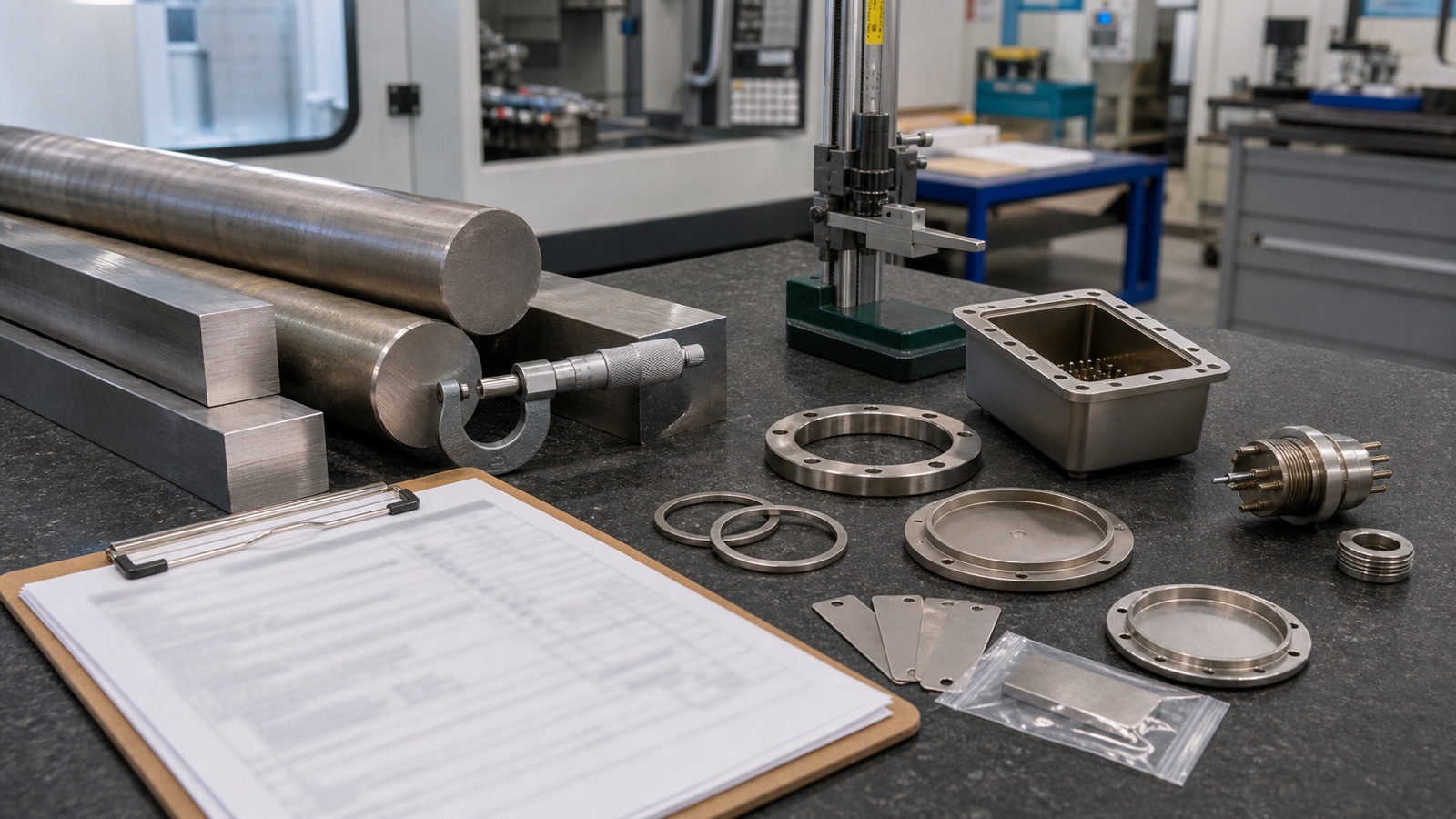
If your application demands hermetic integrity, dimensional precision, and material traceability — and you're looking for a machining partner who genuinely understands ASTM F15 — I'd like to hear from you. At KELTRYN, we build custom Kovar housings, lids, sealing rings, flanges, and complex precision components day in and day out. We handle the material challenges that make other machine shops nervous: thin-wall deformation, burr control, tight tolerances, and the demanding surface requirements of glass and ceramic sealing.
Send us your 2D drawing, your 3D model, or even a rough idea of what you're trying to build. We'll give you practical manufacturability feedback, a clear quote, and the confidence that your parts are in the hands of engineers who understand what hermetic reliability really takes. Contact us today to get your project started.
RFQ Support
Send Your Kovar Machining RFQ
Share drawings, CAD files, material requirements, quantities, tolerances, finishing needs, inspection requirements, and your target timeline. Our team will review the details and respond by email.
Helpful RFQ details
- 2D drawings or 3D CAD files
- Material: Kovar / ASTM F15 / Fe-Ni-Co alloy
- Quantity, tolerance, finish, inspection needs
- Application and purchasing timeline
Direct email: info@kovarmachining.com