Kovar vs Stainless Steel: Key Differences, Properties, and When to Use Each
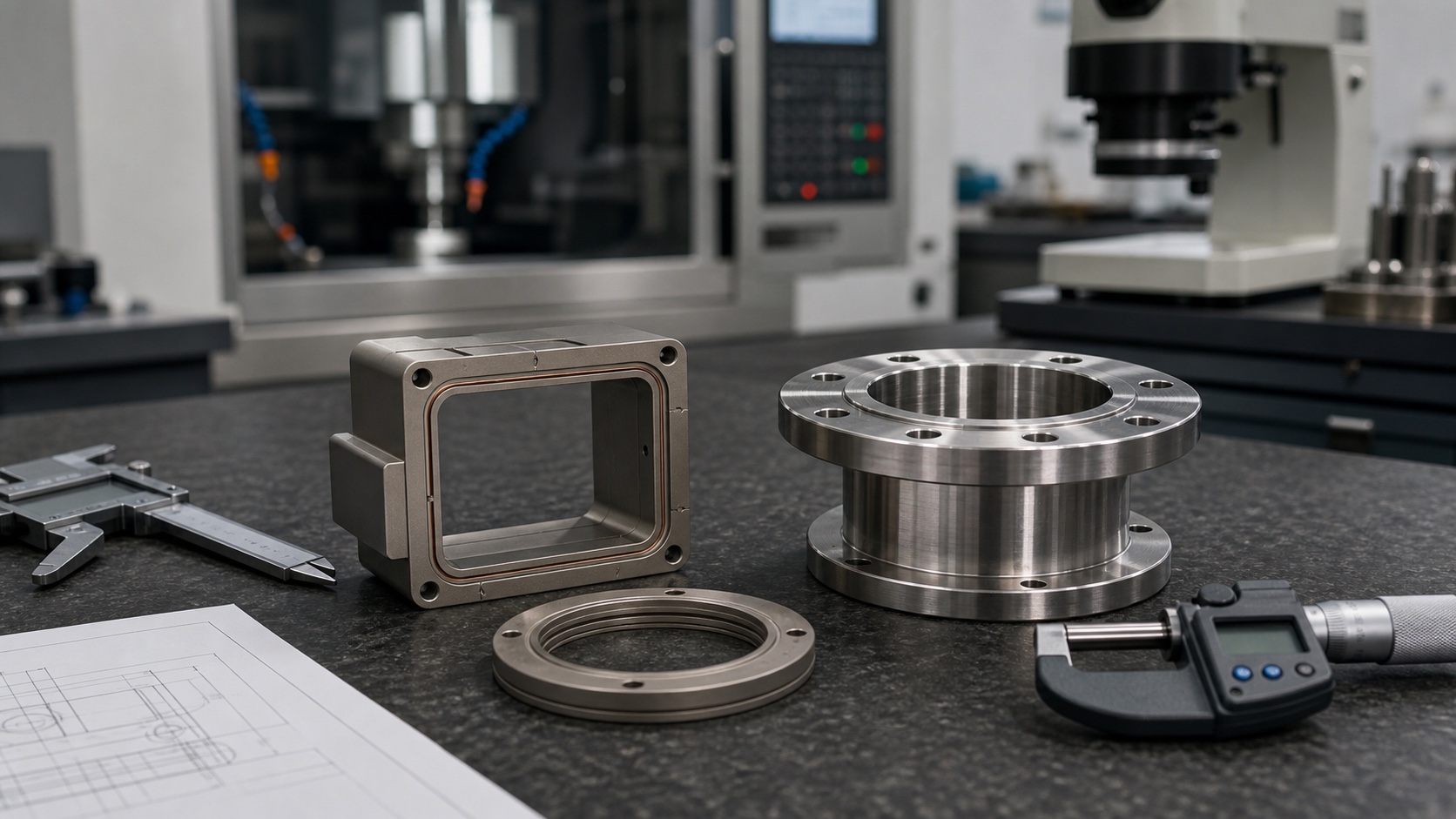
At KELTRYN, we spend our days machining Kovar and Fe-Ni-Co alloys for hermetic, high-reliability applications. One question we hear constantly from engineers and sourcing teams is: “Should I use Kovar or stainless steel for this part?” It’s a fair question—both are iron-based alloys with overlapping visual appearances—but they serve fundamentally different purposes. Let me walk through what sets them apart, where each excels, and how to make the right choice for your project.
What Are Kovar and Stainless Steel?
Let’s start with clear definitions, because confusion here can lead to costly design mistakes.
Kovar is a nickel-cobalt-iron alloy (roughly 29% Ni, 17% Co, balance Fe) that was developed specifically to match the thermal expansion of borosilicate glass and certain ceramics. Its signature property is a low coefficient of thermal expansion (CTE) that remains stable over a wide temperature range. Kovar is not a stainless steel—it contains no significant chromium, so it lacks the passive oxide layer that gives stainless steels their corrosion resistance.
Stainless steel refers to a large family of iron-chromium alloys (typically 10–20% Cr, with varying amounts of nickel, molybdenum, and other elements) designed primarily for corrosion resistance and mechanical strength. The chromium forms a thin, self-healing oxide layer that protects the material in harsh environments.
A common misconception we encounter is that Kovar is just a “special type of stainless steel.” It is not. The two materials overlap in some machining characteristics but diverge completely in thermal behavior, corrosion resistance, and application suitability.
Composition and Basic Properties
| Property | Kovar (ASTM F15) | Stainless Steel 304 (typical) |
|----------|----------------|-------------------------------|
| Composition | 29% Ni, 17% Co, ~54% Fe | 18% Cr, 8% Ni, ~74% Fe |
| Density | ~8.3 g/cm³ | ~8.0 g/cm³ |
| Melting Point | ~1450°C | ~1400–1450°C |
| Tensile Strength | ~550 MPa | ~600 MPa |
| CTE (25–300°C) | 5.3 × 10⁻⁶/°C | 17.3 × 10⁻⁶/°C |
| Magnetic | Yes (ferromagnetic) | Varies (304 is non-magnetic; 430 is magnetic) |
The magnetic behavior differences are often relevant in electronic assemblies. Kovar is ferromagnetic, which can affect RF or sensor performance. Austenitic stainless steels like 304 and 316 are non-magnetic, while ferritic and martensitic grades are magnetic. Always check your application’s magnetic interference requirements.
Key Similarities and Differences at a Glance
Visually, both can look similar after machining—a clean silver-gray surface. Both are available in bar, sheet, and plate forms. Both work-harden to some degree. But the differences dominate:
- Thermal expansion: The single biggest differentiator. Kovar’s CTE is roughly one-third that of 304 stainless steel.
- Corrosion resistance: Stainless steel wins hands down in humid, salty, or acidic environments.
- Strength: Stainless steel generally offers higher yield and tensile strength, though Kovar holds up well in moderate temperature service.
- Weldability: Both can be welded, but Kovar requires careful control to avoid cracking, especially when joining to dissimilar metals.
- Cost: Kovar is 2–4 times more expensive per kilogram than standard stainless grades.
Thermal Expansion: The Defining Difference
This is the one property that determines the material choice for many engineers. The coefficient of thermal expansion (CTE) describes how much a material expands per degree Celsius of temperature change. In precision assemblies—especially those involving glass or ceramic seals—mismatched expansion creates stress, cracking, and eventual failure.
Kovar’s CTE is engineered to match that of borosilicate glass (Pyrex) and alumina ceramics across a typical service range of -60°C to +450°C. At these temperatures, Kovar expands and contracts at almost exactly the same rate as the sealing material. Stainless steel 304, by contrast, expands nearly three times more over the same temperature range.
Why Kovar Excels in Glass-to-Metal Sealing
The hermetic sealing process relies on a controlled oxide layer on the Kovar surface. When the metal is heated with molten glass, a chemical bond forms between the Kovar oxide and the glass. This creates a vacuum-tight, mechanically robust seal that can withstand thermal cycling without cracking.
Typical applications include:
- Vacuum tube bases
- Semiconductor package feedthroughs
- Fiber optic module housings
- Hermetic connectors for aerospace and defense
- X-ray tube windows
Stainless steel cannot seal directly to glass without a special interlayer or coating. Its high CTE would cause the glass to crack as the assembly cools from sealing temperature. If a stainless steel part absolutely must join to glass, engineers sometimes use an intermediate “graded seal” ring of Kovar or other low-expansion alloy, but that adds cost and complexity.
How Stainless Steel Behaves Under Temperature Changes
In non-sealing applications, stainless steel’s high expansion is often perfectly acceptable. For example, a stainless steel enclosure in a food processing plant experiences gradual temperature changes, and expansion joints or flexible elements can accommodate movement.
However, if you embed a stainless steel component into a ceramic circuit board or mount it to a low-expansion frame, you risk mechanical stress, warping, or joint failure. We’ve seen engineers try to substitute stainless steel for Kovar in hermetic seals to save cost—it nearly always ends in rework or field failure. The physics simply don’t support it.
Mechanical Strength and Corrosion Resistance
Let’s compare the two materials in terms of structural performance and durability.
Strength and Structural Use
Stainless steel is the clear winner for load-bearing components. Typical 304 stainless has a tensile strength of about 600 MPa and elongation of 40–50%, making it ductile and impact-resistant. Kovar’s tensile strength is around 550 MPa with ~30% elongation. In most structural roles, stainless steel offers equal or better performance at lower cost.
Kovar retains its strength reasonably well up to about 450°C, but it is not designed for high-stress applications. In our experience, Kovar parts like thin-wall housings or sealing rings should be designed with stress relaxation in mind—especially if they will be bolted or clamped at elevated temperatures.
Corrosion Resistance: Which Material Lasts Longer?
If your product will see moisture, salt spray, acids, or chlorides, choose stainless steel—period. Stainless steel 316, with its molybdenum addition, is particularly resistant to pitting and crevice corrosion in harsh environments. 304 is suitable for indoor and mild outdoor use.
Kovar has limited corrosion resistance because it contains no chromium. Its surface can oxidize (rust) in humid or salty air. In dry, controlled environments (like inside a sealed electronic package), Kovar performs well. But if the part will be exposed, we always recommend a protective coating: gold, nickel, tin, or even epoxy paint.
Will Kovar rust? Yes, it can. Though Kovar contains nickel and cobalt, its iron content is high enough that surface oxidation occurs in the presence of moisture. That’s why many Kovar parts are plated before final assembly.
Machining and Fabrication Considerations
Both materials present machining challenges, but Kovar requires a more specialized approach.
Challenges in Machining Kovar
Kovar is tough and aggressively work-hardens. If you let the tool dwell or take a light cut, the surface becomes harder and more abrasive, reducing tool life and damaging surface finish. At KELTRYN, we use sharp carbide or CBN tools, with consistent feed rates and adequate depth of cut to get under the hardened layer.
Key points for Kovar machining:
- Work hardening: Use sharp tools, never let the tool rub.
- Tool wear: Carbide with TiAlN or AlTiN coatings works well; CBN for finishing passes.
- Chip control: Kovar produces stringy, continuous chips. Use chip breakers and high-pressure coolant.
- Heat management: Cutting generates significant heat; use ample coolant (water-miscible or non-chlorinated oil). Avoid sulfur-based cutting oils—they can contaminate the surface for subsequent glass sealing or plating.
- Dimensional stability: Residual stresses can cause thin-wall parts to distort. Stress-relieving (typically 850–950°C in an inert atmosphere) is sometimes necessary after roughing.
Stainless Steel Machinability vs. Kovar
Stainless steel is more widely machined in general shops. Free-machining grades like 303 and 416 are significantly easier to cut than Kovar. Even standard 304, while work-hardening, is more forgiving than Kovar in terms of tool life and surface finish.
If your shop is set up for general stainless steel work, you can likely handle Kovar—but expect slower speeds, shorter tool life, and the need for better process control. That’s why many engineers come to us: we’ve built our processes around Kovar’s quirks.
Cost and Availability
Cost is a major factor in material selection. Let’s break it down.
Raw Material and Processing Costs
- Kovar raw material: $25–50 per kg (depending on form and quantity). Compare to 304 stainless steel at $3–6 per kg for the same form factors. The cobalt content drives Kovar’s price premium.
- Machining cost: Kovar’s slower cutting speeds (often 50–70% of stainless speeds) and shorter tool life add cost. A part that might take 10 minutes in 304 could take 15–20 minutes in Kovar.
- Post-processing: Plating or coating for Kovar is often required, adding $0.50–$2 per part depending on spec.
Total Cost of Ownership for Your Application
For a low-volume precision component that requires hermetic sealing, Kovar is cost-effective despite high material cost. The alternative—using stainless steel with a graded seal—would add more process steps and likely cost more overall.
For high-volume structural parts where corrosion resistance is sufficient, stainless steel is the clear economical choice. Even if you add a coating to Kovar, you’re paying more per part without gaining the thermal properties you don’t need.
Common Applications: Where Each Material Shines
The application decides the material.
Kovar in Electronics, Aerospace, and Medical Devices
- Electronics: Hermetic connector housings, transistor bases, microwave packages, fiber optic feedthroughs, and power module lids.
- Aerospace: Sensor housings for engine control, satellite optical mountings, cryogenic instrument housings.
- Medical: Implantable pacemaker feedthroughs, endoscope optics, surgical instruments requiring glass-to-metal seals.
Trends we see: miniaturization demands thinner walls and tighter tolerances. Thermal cycling requirements are increasing as devices see wider temperature ranges. Kovar remains the go-to for these challenges.
Stainless Steel in Structural, Food, and Marine Environments
- Structural: Building frameworks, automotive chassis components.
- Food processing: Mixing tanks, conveyor parts, kitchen equipment—sanitary surfaces matter.
- Marine: Propellers, pumps, fasteners—316 and duplex grades resist saltwater.
- Medical: Surgical instruments, orthopedic implants (where sealing is not required).
Stainless steel is also less brittle than Kovar at cryogenic temperatures, making it preferred for liquid nitrogen or LNG applications.
Kovar Equivalents and Alternatives
If you specify Kovar, you might see it called ASTM F15, Alloy K‑941, Nilo K, or Dilaton. All refer to the same nominal composition.
For lower CTE than Kovar, engineers sometimes consider Invar (Fe‑Ni 36%). Invar has the lowest CTE of common alloys (~1.2 × 10⁻⁶/°C) but does not contain cobalt and does not seal well to glass—its oxide layer is not compatible.
Alloy 42 (Fe‑Ni 42%) is a cheaper alternative for lower-temperature sealing (up to ~300°C). It is often used in semiconductor packaging for certain glass types.
No material fully replaces Kovar for matched glass-sealing over a wide temperature range. If you need that property, stick with Kovar.
Frequently Asked Questions (FAQ) – Answering Top Queries
Is Kovar a stainless steel?
No. Kovar contains no significant chromium, so it lacks the corrosion resistance that defines stainless steel.
Will Kovar rust?
Yes. Kovar can rust because it contains iron and has no passive chromium layer. In humid or salty environments, surface oxidation occurs. Plating (gold, nickel, tin) is typically applied to prevent rust.
What metal is better than stainless steel?
It depends on the requirement. For low thermal expansion: Kovar. For corrosion and strength: stainless steel. For extremely low CTE: Invar. There is no universal “better” metal.
What is Kovar equivalent to?
ASTM F15, K‑941, Nilo K, Dilaton. Alloy 46 is similar but with lower expansion target—not interchangeable for all sealing glasses.
Conclusion: How to Choose Between Kovar and Stainless Steel
Here’s my practical advice for engineers evaluating the choice:
- Check thermal expansion needs. Does your assembly involve glass or ceramic sealing, especially over a wide temperature range? If yes, use Kovar.
- Evaluate corrosion environment. Is the part exposed to moisture, chemicals, or salt? If yes, use stainless steel unless the sealing requirement overrides.
- Consider mechanical loads. Load-bearing parts generally favor stainless steel.
- Review budget and volume. For low-volume precision sealing, Kovar is worth the cost. For high-volume structural parts, stainless steel wins.
- Talk to a specialized machine shop early. Kovar machining requires experience. We’ve saved customers from rework by suggesting design changes for manufacturability—before cutting begins.
A simple decision: Need hermetic glass-to-metal seal? → Kovar. Cost or corrosion primary? → Stainless steel.
If you’re still uncertain, prototype with both materials. We often quote both options for new designs, helping teams compare cost and performance. And if you choose Kovar, we’d welcome the opportunity to machine your components with the precision and reliability that high-reliability applications demand.
Contact KELTRYN to discuss your next Kovar or Fe-Ni-Co alloy project. We’ll provide DFM feedback, material traceability, and the engineering support you need from prototype through production.
RFQ Support
Send Your Kovar Machining RFQ
Share drawings, CAD files, material requirements, quantities, tolerances, finishing needs, inspection requirements, and your target timeline. Our team will review the details and respond by email.
Helpful RFQ details
- 2D drawings or 3D CAD files
- Material: Kovar / ASTM F15 / Fe-Ni-Co alloy
- Quantity, tolerance, finish, inspection needs
- Application and purchasing timeline
Direct email: info@kovarmachining.com