Kovar vs Invar: Key Differences, Properties, and How to Choose
When a design engineer hands me a drawing with a note that says “CTE must match borosilicate glass,” I know immediately which alloy they need. But when the requirement is simply “lowest possible thermal expansion over a wide temperature range,” the choice isn’t as obvious. Over the years at KELTRYN, we’ve machined thousands of components from both Kovar and Invar, and I’ve learned that the differences between these two nickel‑iron alloys run deeper than a number on a datasheet. In this article, I’ll walk through exactly what distinguishes Kovar from Invar, when to use each, and how to avoid common pitfalls during machining and application.
What Are Kovar and Invar?
Let’s start with the basics. Both are ferrous alloys with high nickel content, but their design intents are fundamentally different.
Kovar – The Glass‑Sealing Alloy
Kovar is a controlled‑expansion alloy with a nominal composition of 29% nickel, 17% cobalt, and the balance iron (Fe‑29Ni‑17Co). It was developed specifically to match the coefficient of thermal expansion (CTE) of borosilicate glass over the typical sealing temperature range (roughly 25 °C to 450 °C). That match — about 5.5 × 10⁻⁶/°C — allows glass and metal to cool together without cracking or delaminating. This property makes Kovar the go‑to material for hermetic feedthroughs, transistor packages, laser diode housings, and any component where a vacuum‑tight glass‑to‑metal seal is required.
Invar – The Low‑Expansion Alloy
Invar is simpler in composition: roughly 36% nickel and 64% iron (Fe‑36Ni), with no cobalt. Its defining characteristic is a CTE that is near zero — approximately 1.2 × 10⁻⁶/°C — across a useful temperature range (often from cryogenic up to about 200 °C). That is roughly one‑fifth the expansion of Kovar. Because of this, Invar is chosen for applications where dimensional stability over temperature is critical: precision rulers, geodetic survey tapes, laser cavity mounts, scientific instruments, and thermostat bimetals.
Side‑by‑Side Comparison: Kovar vs Invar
To make an informed choice, you need to compare the two alloys across several properties. Here’s a breakdown based on our machining experience and materials data.
Thermal Expansion Coefficient
This is the single most important differentiator.
- Kovar: CTE ≈ 5.5 × 10⁻⁶/°C (25 – 450 °C)
- Invar: CTE ≈ 1.2 × 10⁻⁶/°C (20 – 100 °C); can be even lower in narrow ranges
If your part must hold a micron‑level dimension over a 50 °C temperature swing, Invar wins. If your part must be sealed to glass without stress fractures, Kovar is the only choice.
Chemical Composition
- Kovar: Fe‑29Ni‑17Co. Cobalt is expensive and adds cost, but also improves corrosion resistance and raises the Curie temperature.
- Invar: Fe‑36Ni. No cobalt. Simpler metallurgy, lower material cost.
Mechanical and Physical Properties
From a machinist’s perspective:
- Strength and hardness: Kovar is harder and stronger. Its ultimate tensile strength is around 480 MPa (annealed), while Invar is softer at about 390 MPa. This makes Kovar slightly less prone to deformation during thin‑wall machining.
- Ductility: Invar is more ductile. That sounds good, but in practice it means Invar is “gummier” during machining and tends to form long, stringy chips that can wrap around tools.
- Magnetism: Both are ferromagnetic at room temperature. Kovar’s Curie point is about 435 °C; Invar’s is lower, around 280 °C. For parts that will see temperatures near 300 °C and need consistent magnetic properties, Kovar is preferable.
Corrosion Resistance
Kovar benefits from its cobalt content — it has noticeably better corrosion resistance than Invar, especially in humid or mildly acidic environments. Invar will develop surface rust quickly if left unprotected. For hermetic packages that must survive years in harsh conditions, Kovar is the safer choice. For indoor precision instruments where the part is enclosed and controlled, Invar is often fine with a light plating or coating.
Machinability and Fabrication
Both alloys are notorious for work hardening. Here’s how they differ in our shop:
- Kovar: With sharp carbide tools, rigid setups, and adequate coolant, Kovar machines reasonably well. It produces short, manageable chips. We can hold tight tolerances (e.g., ±0.0005 in / 12 µm) without excessive tool wear.
- Invar: Invar is more challenging. Its ductility makes it “gummy” — chips tend to be long and stringy, and the material can smear rather than cleanly shear. This leads to built‑up edge on the tool, burrs, and difficulty holding fine surface finishes. We use slower spindle speeds, higher feed rates, and copious lubricant to control the cut. Post‑machining, some Invar parts require stress‑relief annealing to prevent delayed distortion.
Both alloys can be welded (TIG is common), but welding introduces residual stresses that can cause distortion. We often recommend a post‑weld heat treatment (stress relief at ~600 °C for Kovar, ~450 °C for Invar) before final machining.
Cost and Availability
- Invar: Material cost is lower because it lacks cobalt. However, machining costs can be higher due to longer cycle times and more frequent tool changes. Overall, Invar parts are often 10–20% cheaper than equivalent Kovar parts, depending on complexity.
- Kovar: More expensive raw material, but faster machining in many cases. Readily available from specialty suppliers like Carpenter or Ed Fagan, typically as round bar or sheet.
When to Use Kovar vs Invar: Application Scenarios
After comparing properties, the choice usually comes down to the application’s thermal expansion needs and sealing requirements.
Electronics and Hermetic Seals (Kovar)
If your part will be sealed to borosilicate glass (or certain ceramics), Kovar is not optional — it’s mandatory. We see it used in:
- Transistor packages and diode bases – where the pin must pass through glass without cracking during thermal cycling.
- Vacuum tube pins – in aerospace and scientific instruments.
- Fiber‑optic feedthroughs – for laser and telecom equipment.
- LED and laser diode housings – where hermeticity is needed to protect sensitive chips.
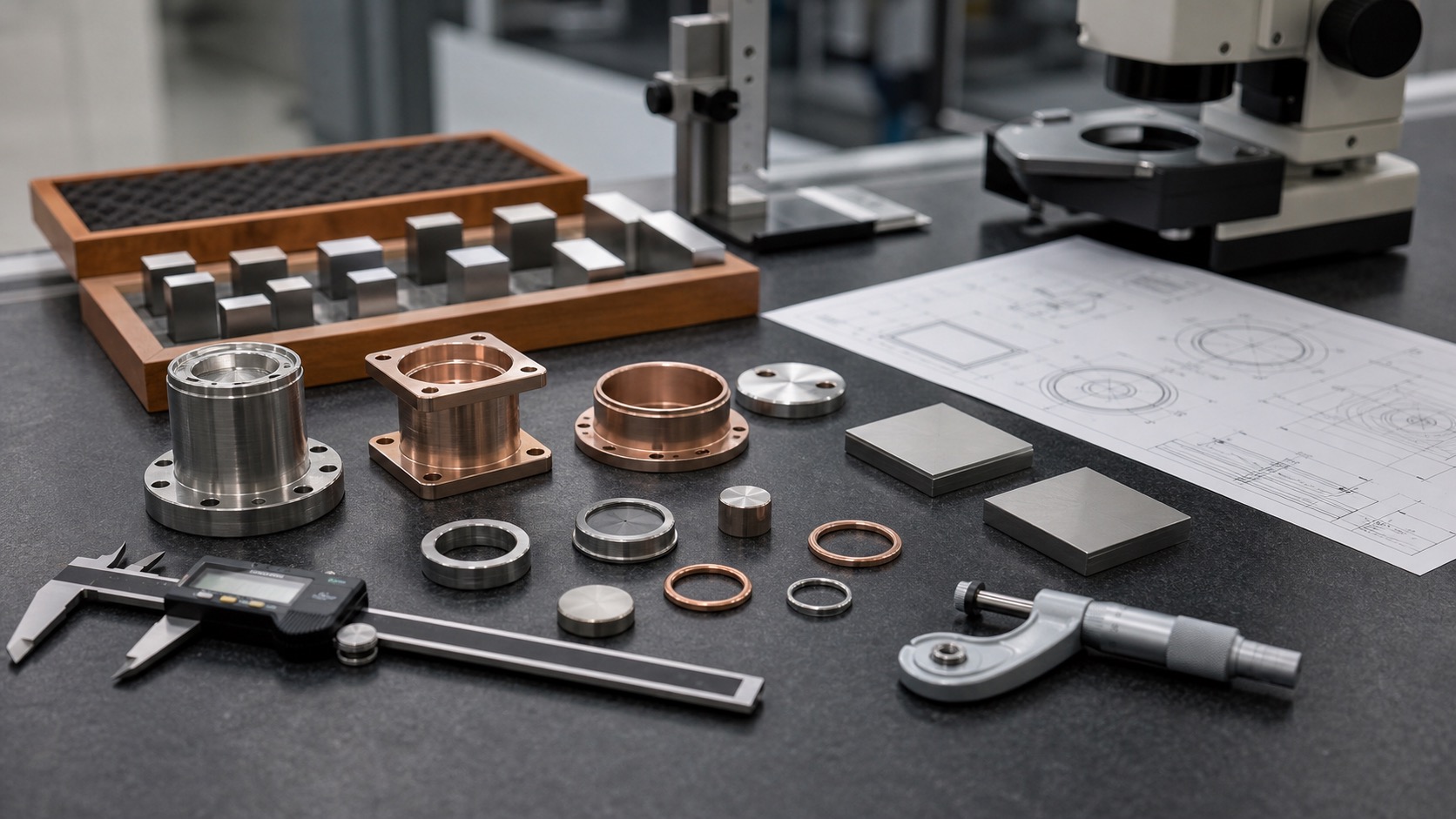
At KELTRYN, we regularly machine Kovar housings, lids, caps, sealing rings, flanges, and frames for exactly these applications. The key challenge is controlling burrs at the sealing surface — any edge defect can create a leak path. We use specialized deburring techniques and inspect every sealing face with a microscope.
Precision Length Standards (Invar)
When dimensional stability over temperature is the primary requirement, Invar is the classic choice:
- Geodetic survey tapes – where expansion over kilometres would introduce unacceptable error.
- Thermostats and bimetallic strips – where the bimetal layer uses Invar’s low expansion as one side.
- Precision rulers and laser interferometry mounts – for metrology labs.
- Cryogenic components – Invar maintains low expansion even at liquid nitrogen temperatures.
Overlap Cases – Which to Choose?
Occasionally a customer asks: “Can I use Invar and then plate it with something to make a glass seal?” The answer is no — Invar’s CTE does not match glass, and no plating can fix that. Conversely, “Can I use Kovar for a precision ruler?” Only if you can tolerate five times more expansion than Invar would provide.
The rare overlap occurs in optical mounts that both need low expansion (for stability) and a glass window (for a viewport). In that case, we might machine the mount from Invar and weld a Kovar flange into it for the window — a hybrid approach. This adds complexity but solves both requirements.
Frequently Asked Questions About Kovar and Invar
What is Kovar equivalent to?
Kovar is covered by ASTM F15, UNS K94610, and is also known under trade names like Fernico. There are no direct equivalents for Invar (ASTM F1684 for strip, but Invar is often specified by composition Fe‑36Ni).
Is Kovar hard to machine?
It can be if you treat it like ordinary steel. The work‑hardening rate is high. We always use sharp carbide inserts, rigid fixturing, and flood coolant. With the right parameters, Kovar machines consistently.
What are the advantages of using Kovar?
The big one is the matched CTE to borosilicate glass, enabling hermetic seals that survive thermal cycling from cryogenic to 450 °C. Kovar also offers moderate electrical conductivity (about 4.5 × 10⁶ S/m) — enough for lead wires and pins — and good corrosion resistance.
Is Kovar a good conductor of electricity?
It is moderate — far lower than copper or aluminum, but adequate for signal pins and small current paths. For high‑current applications, copper‑core Kovar pins (copper‑clad) are sometimes specified.
Can Kovar be used instead of Invar?
Only if your CTE requirement is around 5 × 10⁻⁶/°C. Kovar’s expansion is about five times that of Invar. If your design depends on near‑zero expansion, Kovar will cause unacceptable dimensional changes.
Are Invar and Kovar magnetic?
Yes. Both are ferromagnetic at room temperature. Invar’s magnetism declines more rapidly with heat due to its lower Curie temperature (≈280 °C vs ≈435 °C for Kovar). For applications requiring consistent magnetic properties at elevated temperatures, Kovar is preferred.
Which is harder to machine: Invar or Kovar?
In our experience, Invar is harder to machine well. Its gummy nature requires slower speeds, more aggressive feeds, and constant lubrication to avoid chip packing and built‑up edge. Kovar is more forgiving, though both demand respect.
Conclusion – Making the Right Choice for Your Project
Key takeaways:
- Use Invar when dimensional stability over temperature is paramount — precision instruments, metrology, cryogenics.
- Use Kovar when you need a hermetic glass‑to‑metal seal — electronics, lasers, sensors.
- Match the CTE to your mating material. Don’t compromise.
- Machine with care — both alloys work‑harden and require sharp tools, rigid setups, and appropriate coolants.
At KELTRYN, we live and breathe these materials. Every day we machine Kovar housings, lids, caps, flanges, rings, and frames for customers who need high‑reliability hermetic components. We also handle Invar jobs when precision trumps everything else. Our team provides design‑for‑manufacturability feedback early, so you avoid costly rework later.
If you’re working on a project that involves Kovar, Invar, or any Fe‑Ni‑Co alloy, I’d be happy to discuss your application. Send us your drawing, CAD model, or even a rough sketch — we’ll give you practical advice on material selection, machining feasibility, and lead time.
Contact KELTRYN today to get your Kovar or Invar components machined right, on time, and with full traceability. Let’s build something reliable together.
RFQ Support
Send Your Kovar Machining RFQ
Share drawings, CAD files, material requirements, quantities, tolerances, finishing needs, inspection requirements, and your target timeline. Our team will review the details and respond by email.
Helpful RFQ details
- 2D drawings or 3D CAD files
- Material: Kovar / ASTM F15 / Fe-Ni-Co alloy
- Quantity, tolerance, finish, inspection needs
- Application and purchasing timeline
Direct email: info@kovarmachining.com