Kovar vs Inconel: Key Differences, Properties, and Applications
When an engineer places Kovar and Inconel side by side, it’s natural to ask: aren’t they both nickel-based alloys? The short answer is yes, but their similarities end there. In my years at KELTRYN, I’ve seen many projects where choosing the wrong one leads to cracked seals, failed assemblies, or unnecessary machining costs. In this article, I’ll walk through composition, performance, machinability, and real-world fit so you can decide with confidence.
What Is Kovar?
Composition and Properties
Kovar – known formally as UNS K94610 or ASTM F15 – is a controlled-expansion alloy of roughly 29% nickel, 17% cobalt, and the balance iron. Its defining characteristic is a very low coefficient of thermal expansion (CTE), around 5 ppm/°C from room temperature up to about 400°C. That range was chosen deliberately: it matches borosilicate glass and certain ceramics almost perfectly.
The alloy is magnetic, with a Curie temperature around 435°C, and it takes plating, brazing, and soldering well. These properties make it a natural choice for hermetic seals.
Key Applications
- Glass-to-metal seals – LED packages, vacuum tubes, laser diodes, and high-reliability electronic headers
- Aerospace components – where dimensional stability is critical, such as gyroscope housings
- Transistor and diode bases – especially in power and RF modules
Advantages and Limitations
Advantages:
- Excellent CTE match to hard glass and ceramics
- Good solderability and brazability
- Relatively easy to machine compared to superalloys
Limitations:
- Strength drops sharply above 400°C
- Poor oxidation resistance; surface rust can occur without protective coating
- Not intended for extreme heat or corrosive environments
What Is Inconel?
Composition and Properties
Inconel is a family of nickel-chromium superalloys (most common grades: 625, 718, 600). The base is nickel with roughly 18–22% chromium, plus molybdenum, niobium (columbium), aluminium, and titanium depending on the grade. These alloys offer high tensile strength, creep resistance, and durability up to 1000°C. They develop a tenacious chromium oxide scale that resists oxidation at high temperatures and withstands reducing and oxidizing acids alike.
Key Applications
- Aerospace turbine blades and exhaust systems
- Chemical processing equipment (reactors, valves, piping)
- Marine engineering – propeller shafts, seawater pumps
- Nuclear reactor components – control rod drive mechanisms, core support structures
Advantages and Limitations
Advantages:
- Exceptional strength retention to 1000°C
- Outstanding corrosion and oxidation resistance
- Non-magnetic (austenitic) structure
Limitations:
- Very difficult to machine – work-hardens rapidly, requires slow speeds and heavy coolant
- Higher material cost than Kovar
- Denser and heavier than some alternatives (e.g., Inconel 718 density ~8.2 g/cm³)
Kovar vs Inconel: Head-to-Head Comparison
Thermal Expansion
Kovar’s CTE (~5 ppm/°C) is nearly an order of magnitude lower than Inconel’s (~13–15 ppm/°C). This single parameter drives the entire application split. If you need a reliable glass-to-metal seal, you must use an alloy with a CTE that matches the glass’s expansion curve from room temperature to the sealing temperature (typically 400–500°C). Inconel expands too much and will crack the glass.
Practical example: At KELTRYN, we frequently machine Kovar housings for high-reliability optical transceivers. Switching to Inconel would create a mismatch that leads to hermeticity failure within thermal cycling.
High-Temperature Performance
Kovar’s maximum continuous use temperature is about 450°C. Beyond that, its strength declines rapidly, and oxidation becomes severe. Inconel, by contrast, operates effectively up to 1000°C with good creep strength. For turbine blades, combustor liners, or furnace fixtures, Inconel is the obvious choice.
Bottom line: Kovar is not a replacement for Inconel in high-heat environments. Use Kovar for dimensional stability, not for load-bearing at elevated temperatures.
Corrosion Resistance
Kovar is prone to rust and scaling in humid or oxidizing environments unless plated (e.g., nickel or gold flash). Inconel forms a stable chromium oxide layer that resists acids, chlorides, and seawater. In chemical processing or marine applications, Inconel wins hands down.
Machinability and Fabrication
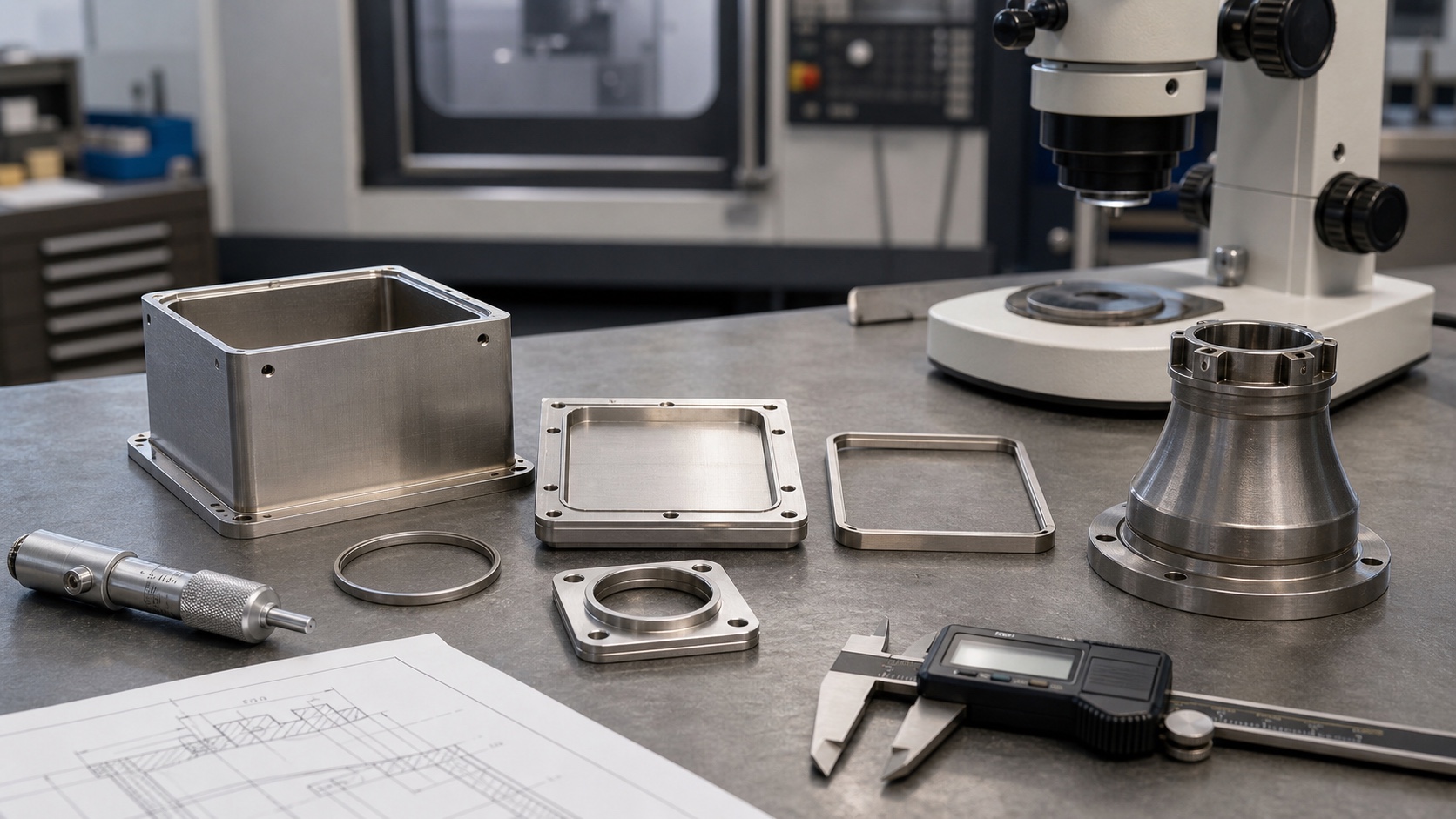
Here, Kovar is the easier material. With standard carbide tooling, good chip control, and moderate speeds, we can produce complex thin-wall housings, precise sealing rims, and internal features with low burr levels. Inconel, on the other hand, is a notorious work-hardener. It demands rigid setups, ceramic or whisker-reinforced inserts, very slow speeds, and abundant coolant. Tolerances are harder to hold, and tool wear is high.
KELTRYN’s experience: We specialise in Kovar and Fe-Ni-Co alloys because our process control focuses on the challenges unique to these materials – thin-wall deformation, burr management, and sealing surface integrity. Inconel parts require a different shop floor approach altogether.
Cost and Availability
The raw material cost of Kovar is typically lower than Inconel – less nickel and no expensive refractory metals like molybdenum or niobium. But Inconel is more widely available in many standard forms (plate, bar, sheet). However, when you factor in machining cost and tooling wear, Kovar parts are generally faster and cheaper to produce.
Implication: Kovar is economical for sealing applications. Inconel’s higher cost is justified only where thermal or corrosion demands are extreme.
Magnetic vs Non-Magnetic
Kovar is magnetic up to its Curie temperature (~435°C). Inconel (austenitic) is non-magnetic. If your assembly includes magnetic field sensors or operates near an MRI, the magnetic property may rule out Kovar.
Kovar vs Inconel in Specific Applications
Glass-to-Metal Seals
Kovar is the standard. Inconel cannot match the CTE and would crack the glass. (For certain ceramic seals, Alloy 42 or Invar may be used, but Kovar remains the most common hard-glass sealing alloy.)
Aerospace Turbine Components
Inconel 718 is the workhorse for blades, disks, casings. Kovar is essentially never used for these dynamic hot-section parts.
Electronic Packages (High-Reliability)
Kovar dominates hermetic packages – headers, feedthroughs, laser mounts. Inconel only appears in specialty high-temperature electronic enclosures, where Kovar would lose strength or oxidise.
Related Comparisons (Incorporating “People Also Ask”)
What Is Better Than Inconel?
It depends on the exact requirement:
- Extreme corrosion → Hastelloy (e.g., C-276)
- Wear resistance at high temperature → Stellite or Tribaloy
- Higher temperature creep → Waspaloy or René alloys
- Lower expansion → Kovar or Alloy 42
Inconel remains an excellent all‑rounder, but alternatives outperform in specific metrics.
Is Stellite Harder Than Inconel?
Yes. Stellite cobalt alloys (e.g., Stellite 6) have significantly higher hot hardness and wear resistance. Inconel is stronger in bulk tensile strength at elevated temperatures. Choose Stellite for abrasive environments (valve seats, cutting tools); choose Inconel for load‑bearing structural parts at high heat.
What Is the Difference Between Kovar and Alloy 42?
Both are low‑expansion Fe‑Ni alloys. Alloy 42 (42% nickel) has a CTE of ~8 ppm/°C, while Kovar uses cobalt to lower CTE to ~5 ppm/°C to match hard glass. Alloy 42 is cheaper and suitable for some soft-glass seals, but for precision hermetic applications, Kovar is preferred.
What Kind of Material Is Kovar?
Recap: Kovar is a controlled-expansion, magnetic, nickel‑cobalt‑iron alloy (UNS K94610) primarily used for glass-to-metal sealing in electronics and aerospace. It offers low CTE and good braze/solder properties, but limited high-temperature and corrosion performance.
How to Choose Between Kovar and Inconel
Here’s a simple decision framework I use when advising customers:
- Do you need a glass-to-metal or ceramic-to-metal seal?
→ Kovar (or possibly Alloy 42).
- Do you require dimensional stability at temperatures over 400°C?
→ Inconel.
- Will the part be exposed to corrosive chemicals or seawater?
→ Inconel.
- Is magnetic permeability a concern?
→ Inconel (non-magnetic).
- Are you machining thin walls, fine threads, or complex internal features?
→ Kovar is easier.
- Budget constraints?
→ Kovar is generally more economical for sealing parts.
In some high‑reliability electronic packages, both materials appear: Kovar for the hermetic feedthrough and Inconel for external high‑temperature shielding. When in doubt, consider the operating environment and manufacturing constraints first.
Frequently Asked Questions (FAQ)
Can Kovar Be Welded?
Yes, but it requires a compatible filler metal – typically a Kovar filler or a nickel‑copper alloy – and a controlled atmosphere (argon or hydrogen) to prevent oxidation. Because of its low thermal expansion, welding can introduce residual stress, so careful joint design is necessary.
Is Inconel Magnetic?
No, Inconel is non‑magnetic in the annealed state. Cold work can induce slight magnetism, but it remains largely non‑magnetic for most engineering purposes.
Which Is Stronger, Kovar or Inconel?
At room temperature, Inconel 718 has a tensile strength around 1300 MPa, while Kovar is about 550 MPa. More importantly, Inconel retains a large fraction of that strength to 700°C and above, while Kovar weakens significantly past 400°C. Inconel is the stronger alloy overall.
Can Inconel Be Used for Glass Seals?
Very rarely. Its high CTE (~13–15 ppm/°C) and poor glass wetting make it unsuitable. Kovar, Invar, or Alloy 42 are preferred for glass-to-metal seals.
Conclusion
Kovar and Inconel serve very different roles. Kovar is the go-to material when you need to match glass expansion and create reliable hermetic seals. Inconel is the right choice when you face extreme heat, corrosion, or both. There is no single “best” – only the right fit for your operating environment and manufacturing constraints.
At KELTRYN, we live and breathe Kovar and Fe-Ni-Co alloys. Our precision CNC machining capabilities – from turning and milling to multi-axis work – are built around the unique demands of these materials: controlling thin-wall deformation, managing burrs on sealing surfaces, and delivering tight tolerances with full material traceability.
Whether you need a prototype Kovar housing or a production run of hermetic lids, I encourage you to reach out. We’ll review your drawing, discuss manufacturability, and help you avoid the pitfalls we’ve seen over years of focused work.
[Contact KELTRYN today](mailto:info@keltryn.com) for a quote or design-for-manufacturing feedback on your next Kovar or Fe-Ni-Co alloy component.
RFQ Support
Send Your Kovar Machining RFQ
Share drawings, CAD files, material requirements, quantities, tolerances, finishing needs, inspection requirements, and your target timeline. Our team will review the details and respond by email.
Helpful RFQ details
- 2D drawings or 3D CAD files
- Material: Kovar / ASTM F15 / Fe-Ni-Co alloy
- Quantity, tolerance, finish, inspection needs
- Application and purchasing timeline
Direct email: info@kovarmachining.com