Is Kovar Magnetic? Understanding the Magnetic Properties of Kovar Alloy
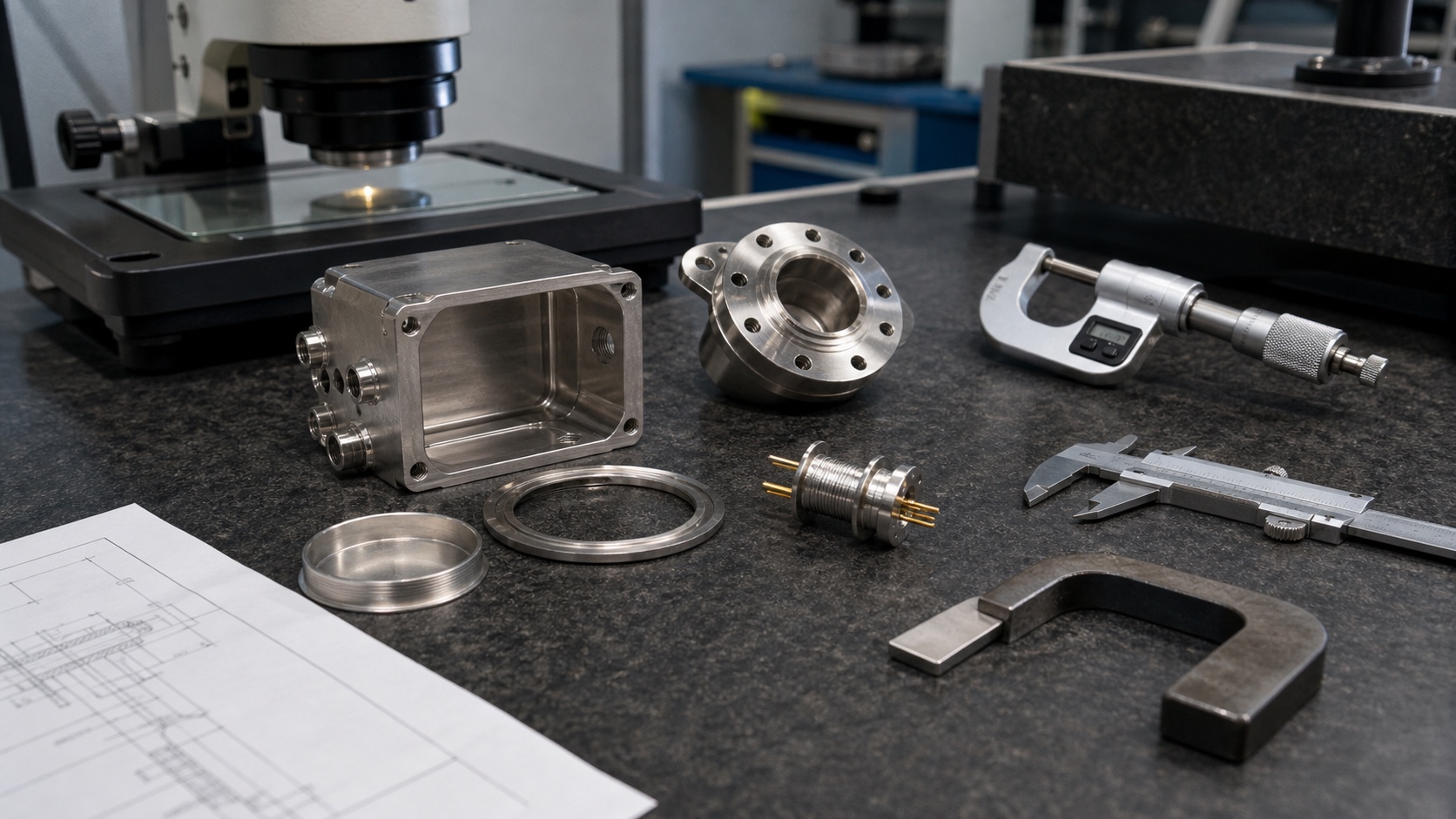
When an engineer first specifies Kovar for a hermetic package or a glass-to-metal seal, the question often comes up in the first design review: "Wait, is Kovar magnetic?" It is a critical question, and the answer is not just a simple yes or no—it affects everything from the machining process to how the part performs in a high-frequency RF circuit or a vacuum tube. Here at KELTRYN, we machine Kovar and other Fe-Ni-Co alloys every day, so we deal with the practical realities of this material's magnetic personality. Let’s break down exactly what makes Kovar magnetic, how it behaves under different conditions, and what that means for your precision-machined components.
What Is Kovar? A Quick Overview
So, what kind of metal is Kovar? In short, it is a nickel-iron-cobalt controlled-expansion alloy. The name "Kovar" is actually a registered trademark of Carpenter Technology Corporation, but it has become the generic term for this specific family of alloys. If you look at the specification sheets, you will typically see it classified under ASTM F15 or UNS K94610 (and sometimes K-9410).
The standard composition is remarkably consistent across manufacturers:
- Nickel (Ni): ~29%
- Cobalt (Co): ~17%
- Iron (Fe): Balance (approximately 53-54%)
- Trace elements: Manganese, Silicon, Carbon (kept to strict minimums)
Kovar's claim to fame is its ability to match the thermal expansion of hard borosilicate glass (like Pyrex®) and certain ceramics (like alumina). When glass or ceramic is fused to a metal, a mismatch in thermal expansion will cause the seal to crack or leak as the assembly cools. Kovar's CTE (coefficient of thermal expansion) is specifically tuned to fuse tightly to these materials, which is why it dominates the glass-to-metal sealing, electronics, and semiconductor packaging industries.
Is Kovar Magnetic? The Short Answer
Let’s get right to the point: Yes, Kovar is magnetic at room temperature.
It is classified as a ferromagnetic material, meaning it exhibits strong attraction to magnets—similar to pure iron or nickel. If you hold a permanent magnet up to a piece of Kovar stock, it will snap to it.
However, there is a critical caveat that engineers must remember: Kovar loses its magnetism above its Curie temperature. For Kovar, this transition occurs at approximately 430–450°C (806–842°F). When the alloy is heated above this threshold, it transitions from being ferromagnetic (strongly magnetic) to paramagnetic (only weakly affected by magnets, essentially non-magnetic for practical purposes).
The one-sentence summary for your design review: Kovar is fully magnetic at room temperature, but it becomes non-magnetic once you heat it above roughly 435°C.
The Science Behind Kovar's Magnetism
Why Is Kovar Ferromagnetic?
To understand why Kovar is magnetic, you only need to look at its constituent elements. Iron (Fe), Nickel (Ni), and Cobalt (Co) are the three primary ferromagnetic elements in the periodic table. Kovar is essentially a custom-tailored mix of these three magnetic metals.
In its solid, annealed state, Kovar's crystalline structure allows these atoms to form something called "magnetic domains." These are microscopic regions where the magnetic moments of the atoms are aligned in the same direction. When the material is exposed to an external magnetic field, these domains rotate and align with the field, causing the material as a whole to become magnetized and attract to magnets. The high Nickel content (around 29%) drives a significant portion of this magnetic behavior, though Cobalt also contributes.
The Curie Temperature and Kovar
The Curie temperature is the physical "off switch" for permanent magnetism. It is the point where thermal agitation overcomes the electron alignment that holds the magnetic domains together.
For Kovar specifically, the Curie temperature is generally cited as ~435°C. Above this point, those neatly aligned domains break down randomly. The material remains chemically identical, but it no longer acts as a magnet.
Why does this matter in real engineering? If you are designing a microwave tube or a high-power vacuum tube, the internal components get incredibly hot. If a metal part becomes magnetic during operation, it can interfere with electron beams or alter the inductive properties of the circuit. Since Kovar loses its magnetic properties at high temperatures, it allows electronic envelopes to remain hermetically sealed without introducing unwanted magnetic interference during the high-heat operation of the tube.
Magnetic Permeability of Kovar
Magnetic permeability (µ) describes how easily a material supports the formation of a magnetic field within itself. For Kovar, this is a moderately soft ferromagnetic property.
- Initial Permeability: Typically around 1,000 (at a low magnetic flux density).
- Maximum Permeability: Can reach up to 4,000.
While Kovar is magnetic, it is not a "soft magnetic" alloy like pure iron or Mu-metal. It's a structural/sealing alloy that happens to be magnetic. Its permeability is considerably lower than pure iron (~200,000 max permeability) or a dedicated magnetic shielding alloy. For applications involving magnetic shielding, engineers usually don't use Kovar as the primary shield unless they are utilizing its matched sealing characteristics. However, understanding the permeability value is essential when calculating signal losses in hermetic connectors or RF enclosures. In high-frequency applications, the magnetic nature of Kovar can increase insertion losses compared to non-magnetic alloys, which is a major reason why some aerospace specs call for strictly non-magnetic alternatives in specific connector pins.
Key Properties of Kovar (Physical, Thermal, Mechanical)
If you are specifying Kovar parts for a high-reliability application, you need the datasheet numbers. Here are the critical values we rely on at KELTRYN when machining and inspecting this alloy.
Physical Properties
- Density: ~8.36 g/cm³ (about the same density as stainless steel).
- Melting Point: ~1450°C (2642°F).
- Electrical Resistivity: ~49 µΩ·cm at room temperature. (This is relatively high compared to pure copper, making it useful for certain resistive elements but requiring care in electrical feedthroughs).
- Appearance: A clean, silvery-gray metallic luster. It takes a good surface finish, which is critical for sealing faces.
- Magnetic Classification: Ferromagnetic (as discussed above).
Thermal Properties
The thermal behavior of Kovar is its reason for existence in engineering.
- Mean Coefficient of Thermal Expansion (CTE) - The Defining Property:
- RT to 300°C (572°F): ~5.3 µm/m·°C
- RT to 500°C (932°F): ~6.0 µm/m·°C
- (Note: Specifically formulated to match borosilicate glass, which is typically around 3.3–5.3 µm/m·°C depending on the exact glass type). This close CTE match is why glass fuses to Kovar without cracking.
- Specific Heat: ~0.46 J/g·°C.
- Thermal Conductivity: ~17 W/m·K at room temperature. (Compare this to copper at ~400 W/m·K or stainless steel at ~16 W/m·K. Kovar is a poor conductor of heat, which is crucial to know for hermetic packages that must dissipate heat; you often need to design in copper heat sinks strategically).
Mechanical Properties
Kovar is usually machined in the annealed condition. Here are the typical mechanical characteristics you'll search for on the mill cert:
- Yield Strength: ~345 MPa (50,000 psi).
- Tensile Strength: ~515 MPa (75,000 psi).
- Elongation: ~30% in 2 inches (which indicates good ductility).
- Hardness: Typically around 80 HRB (Rockwell B) or approximately 140-170 Vickers.
Because of its decent ductility and relatively low hardness, Kovar can be formed and deep-drawn easily. However, as we’ll cover below, those same characteristics create specific challenges for CNC machining.
Applications That Rely on Kovar's Magnetic and Thermal Behavior
Kovar isn't just a metal; it's an engineered solution. Its precise thermal expansion matching and predictable magnetic transition enable a wide range of critical technologies.
- Glass-to-Metal and Ceramic-to-Metal Seals: This is the core application. KELTRYN machines the housings, sealing rings, flanges, and lids that get fused to glass insulators. Because the CTE matches, these seals survive brutal thermal cycling without fracturing.
- Electronics and Semiconductor Packaging: Kovar is the go-to material for IC lead frames, Hermetic transistor packages, and high-reliability connectors. The magnetic properties are often leveraged to hold components in place during automated assembly before heat is applied.
- Power Tubes and Microwave Tubes: Here is where the Curie temperature shines. High-power vacuum tubes and microwave tubes (like traveling-wave tubes or klystrons) rely on Kovar's ability to transition from magnetic (for assembly and control) to non-magnetic (during high-temperature operation) to maintain electron beam trajectories without distortion.
- Aerospace and Defense Electronics: Flight-critical sensors, RF cavities, and radar components require materials with predictable behavior. Kovar's reliability in extreme environments makes it a staple for military-grade avionics and satellite communications.
- Medical Devices and Implantables: Kovar is used in the hermetic feedthroughs of pacemakers and neurostimulators. Its thermal properties allow a perfect glass seal, and while many think "non-magnetic" is required for MRI compatibility, Kovar is often used in specific configurations where its properties are carefully accounted for and tested.
- Photonics and Optoelectronics: Laser diode packages and fiber-optic transceiver housings use Kovar to support laser modules. The material's thermal expansion matches the glass fibers and optical components, maintaining precise alignment over a wide temperature range—critical for high-bandwidth data transmission.
Is Kovar Hard to Machine?
This is one of the first questions engineers ask us at KELTRYN when they are evaluating their supply chain. The honest answer is: Yes, Kovar can be challenging to machine, but it is an absolute joy to machine when you know exactly how it behaves.
Kovar has a notorious "gummy" tendency. It is not brittle like sintered ceramics or super-hard like HSS. When you take a heavy cut, it tends to tear and smear rather than cleave cleanly. It also has a moderate work-hardening rate. If your tooling gets dull and starts rubbing instead of cutting, the surface instantly hardens, ruining your tool edge and leaving a poor surface finish.
At KELTRYN, approaching a Kovar job requires specific operational discipline:
- Tooling: We use sharp, polished carbide tooling. Geometry is everything. You need positive rake angles to shear the material cleanly and avoid chatter.
- Coolant: Flood coolant is essential. You must use high-pressure coolant to manage the heat at the cutting zone and prevent chip welding.
- Speeds and Feeds: Lower surface feet per minute (SFM) than you might use for steel, combined with a consistent, moderate feed rate. The worst case is a feather-light cut with a dull tool—it will just work-harden the surface.
- Annealing: We ensure the material is in the annealed condition prior to machining. If you try to cut work-hardened or pre-hardened stock, you're setting yourself up for cracked inserts and scrapped parts.
- Alternative Processes: For thin-wall parts, like frames and lids, where the material just doesn't have the rigidity for chip cutting, we often switch to Electrical Discharge Machining (EDM), laser cutting, or photoetching. These processes don't induce the mechanical stress that causes thin Kovar to warp.
Finally, welding and brazing Kovar is entirely viable, but it requires clean surfaces and precise temperature control to prevent void formation in hermetic seals. We always build in deburring and stress-relieving steps after machining to ensure the final component is dimensionally stable for the customer's subsequent glass-sealing operations.
Corrosion Resistance of Kovar
If you are coming from a stainless-steel background, you need to adjust your expectations. Kovar does not have great intrinsic corrosion resistance.
Its corrosion resistance is considered moderate in dry indoor environments. It can resist normal atmospheric oxidation, but it is definitely not "rust-proof." Kovar will form a surface iron oxide (rust) when exposed to moisture, humidity, or salt air. This rust not only compromises the cosmetic appearance but also ruins the hermetic seal capability.
Here is the practical engineering workaround: Protective Plating. In high-reliability applications, Kovar is almost always plated before final assembly.
- Nickel Plating is applied as a standard barrier layer before glass sealing or brazing.
- Gold Plating is commonly applied to Kovar used in semiconductor packages and medical devices to ensure corrosion resistance, low contact resistance, and excellent solderability.
Compared to 304 or 316 stainless steel, Kovar is far less corrosion-resistant. If your environmental spec requires salt-spray resistance and you cannot plate the part, Kovar may not be the right choice for the outer housing, or you will need a robust passivation/plating specification.
Kovar Composition and Specifications
ASTM F15 Standard Composition
If you are sourcing Kovar, you will buy it to the ASTM F15 standard (also known as ASTM F15-78 for the chemical composition). To guarantee the exact, controlled thermal expansion, the chemistry is held within a tight window:
- Nickel (Ni): 28.5% – 29.5%
- Cobalt (Co): 16.5% – 17.5%
- Manganese (Mn): ≤ 0.50%
- Silicon (Si): ≤ 0.30%
- Carbon (C): ≤ 0.04%
- Aluminum, Magnesium, Zirconium, Titanium: Trace amounts, strictly controlled.
- Balance: Iron (Fe)
Why is this so tight? Every percentage point of Nickel or Cobalt shifts the Curie temperature and the coefficient of thermal expansion. If a supplier sends you an off-spec heat, your glass-to-metal seals will fail under thermal stress. This is why KELTRYN demands material certification and lot traceability for every single bar or blank we machine. We stamp and serialize parts to the specific heat number so our customers have an unbroken chain of custody.
Specifications and Cross-References
Depending on the global market or the end-user spec, you might see different names for the same alloy. It's critical to know these cross-references so there's no confusion on the shop floor or in procurement.
- Kovar®: The original Carpenter Technology trade name.
- ASTM F15: The dominant industrial standard in North America.
- MIL-I-23011: The old US military specification for this alloy.
- Nilo K: The equivalent alloy manufactured by Special Metals Corporation.
- DIN/ISO: In Europe, you might see it classified under DIN 17745 (material number 1.3981) or similar "K-9410" designations.
- GE Alloy: Sometimes referred to in historical datasheets simply as "F15 Alloy."
Frequently Asked Questions About Kovar
Q: Is Kovar magnetic at high temperatures?
Kovar remains magnetic as it heats up until it reaches its Curie temperature of approximately 435°C (815°F). Once it crosses this threshold, it becomes paramagnetic and effectively non-magnetic. As it cools back down, it regains its magnetic properties.
Q: What kind of metal is Kovar?
Kovar is a specialized nickel-iron-cobalt (Fe-Ni-Co) controlled-expansion alloy. It is specifically formulated to match the thermal expansion characteristics of borosilicate glass and certain ceramics, making it the essential metal for hermetic glass-to-metal seals.
Q: Is Kovar hard to machine?
It can be. Kovar is a "gummy," ductile material that work-hardens quickly. Successful machining requires sharp carbide tooling, aggressive geometries, ample high-pressure coolant, and strict control of speeds and feeds. For thin sections, EDM or photoetching is often preferred over traditional cutting.
Q: What is the thermal conductivity of Kovar?
Kovar has a relatively low thermal conductivity of approximately 17 W/m·K at room temperature. This is comparable to stainless steel and far lower than copper or aluminum. This low conductivity means thermal management must be carefully addressed in package design.
Q: Does Kovar rust?
Yes, Kovar can tarnish and rust if left uncoated in humid or harsh environments. While it has moderate resistance in dry air, it requires protective plating, typically nickel and/or gold, to ensure long-term reliability and corrosion resistance in hermetic electronic packages.
Q: Can Kovar be used in medical implants?
Yes. Kovar is widely used in the hermetic feedthroughs that pass through the titanium housings of implantable medical devices like pacemakers. While it isn't a "noble" metal, its thermal expansion match with glass allows for a perfect hermetic barrier, and when properly gold-plated, it is biocompatible for these specific encapsulated applications.
Conclusion — Key Takeaways on Kovar's Magnetism
To answer the headline question directly: Is Kovar magnetic? Yes, absolutely. At room temperature, it behaves like iron or nickel, exhibiting strong ferromagnetic properties. But the deeper engineering story lies in its Curie temperature—the point near 435°C where Kovar completely drops its magnetic personality and becomes non-magnetic. This unique combination of thermal expansion matching and a magnetic "off switch" is why Kovar continues to dominate high-reliability, hermetic, and high-temperature applications.
At KELTRYN, we've built our machining processes around the unique challenges of Kovar. We understand its gummy chip behavior, its work-hardening quirks, and its need for precise thermal management during machining. Whether you need a custom Kovar housing, a thin-wall lid, a flanged vacuum component, or a complex RF enclosure, our team has the expertise to manufacture your parts to the exact tolerances required for hermetic sealing and long-term field reliability.
If you are looking at a 2D print or a 3D model and wondering if Kovar will work for your application—or how to machine it without tearing your hair out—send it to us. We're here to provide manufacturability feedback, material traceability, and precision-machined prototypes and production runs. Contact KELTRYN today and let's engineer your Kovar solution together.
RFQ Support
Send Your Kovar Machining RFQ
Share drawings, CAD files, material requirements, quantities, tolerances, finishing needs, inspection requirements, and your target timeline. Our team will review the details and respond by email.
Helpful RFQ details
- 2D drawings or 3D CAD files
- Material: Kovar / ASTM F15 / Fe-Ni-Co alloy
- Quantity, tolerance, finish, inspection needs
- Application and purchasing timeline
Direct email: info@kovarmachining.com