Is Kovar Corrosion Resistant? Understanding Its Limits, Coatings, and Best Alternatives
If you're designing hermetic packages, glass-to-metal seals, or precision electronic enclosures, you've likely encountered Kovar. It's the go-to alloy for matching the thermal expansion of borosilicate glass and ceramic, and it's the backbone of countless high-reliability components. But every time I sit down with a customer who's new to the material, the same question comes up: is Kovar corrosion resistant?
It's a fair question, and the answer is more nuanced than a simple yes or no. As an engineer who works with Kovar every day at KELTRYN, I've seen what happens when this material is used correctly — and what happens when corrosion behavior is misunderstood. Let's break it all down.
What Is Kovar? A Quick Material Overview
Kovar is a nickel-cobalt-iron alloy, typically made up of approximately 29% nickel, 17% cobalt, and a balance of iron, with small amounts of manganese and silicon. Its signature property is an extremely low coefficient of thermal expansion (CTE), roughly 5.2 to 5.8 ppm/°C between room temperature and 400°C. That makes it an exceptional match for borosilicate glasses and certain alumina ceramics, which is why it's the standard material for glass-to-metal and ceramic-to-metal sealing.
You'll find Kovar in:
- Hermetic electronic packages and feedthroughs
- Semiconductor packaging and IC lead frames
- X-ray tubes and vacuum electronics
- Microwave and RF components
- Aerospace sensors and connectors
- Sealed relays and transistor cases
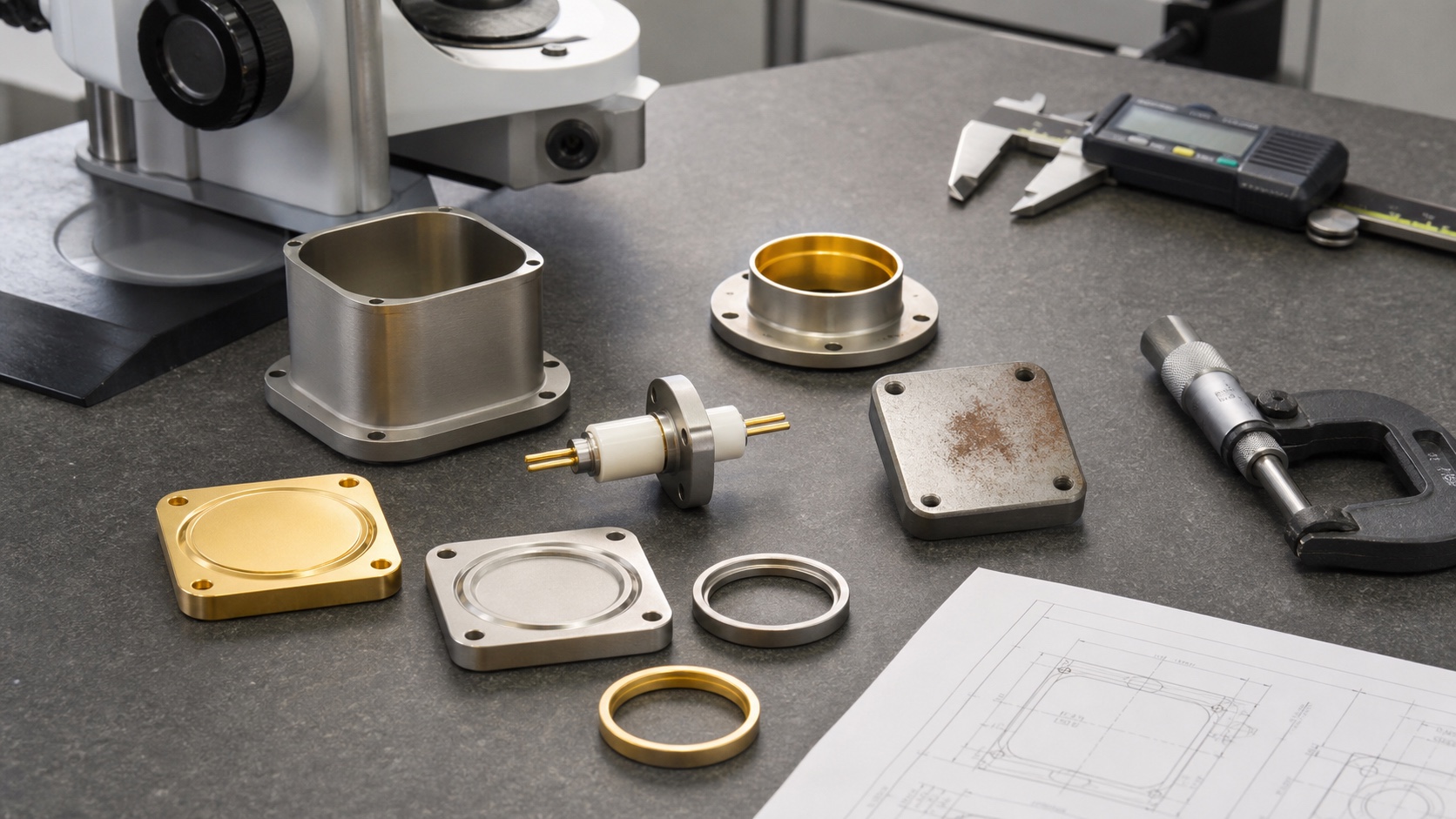
Common specifications include ASTM F15 and UNS K94610, and you'll sometimes hear it referenced by trade names like Dilvar or Nilco. At KELTRYN, we machine Kovar components — housings, lids, caps, sealing rings, flanges, and frames — for customers who need tight tolerances and reliable sealing surfaces. The material's characteristics drive a lot of our process decisions, from tooling to heat management to deburring.
Is Kovar Corrosion Resistant? The Short Answer
Here's the straightforward answer: Kovar offers only moderate corrosion resistance. It is not inherently corrosion-proof.
The corrosion behavior of Kovar is often compared to low-carbon steel — not to stainless steel. In humid air, salt-laden environments, or exposure to certain chemicals, bare Kovar will oxidize and form rust. The surface can develop a reddish-brown tint, and in more aggressive conditions, pitting and localized corrosion can follow.
Why does this matter? Because Kovar's primary engineering purpose is thermal expansion matching, not corrosion resistance. When a designer selects Kovar, they're doing it to create a reliable hermetic seal with glass or ceramic. But that same part may sit in a humid warehouse, undergo salt spray testing, or live inside an aerospace module for decades. Understanding its environmental limits is critical.
It's also important to note that corrosion resistance depends heavily on surface finish, environment, and whether protective coatings are applied. A freshly machined Kovar part with a clean, smooth surface will behave very differently from a scratched part exposed to salt spray. And in nearly every real-world application, Kovar is plated or coated before it goes into service — which completely changes the conversation.
How Kovar's Composition Affects Its Corrosion Behavior
To really understand Kovar's corrosion behavior, we have to look at what's in the alloy.
- Nickel (29%) contributes toughness and gives Kovar a moderate baseline level of corrosion resistance. Nickel helps the alloy resist some forms of attack, but it doesn't create the protective passivation layer that stainless steels rely on.
- Cobalt (17%) adds strength, hardness, and important magnetic properties. From a corrosion standpoint, cobalt provides essentially no meaningful benefit. It's there for thermal expansion control and mechanical performance.
- Iron (balance) is the problem child. Iron wants to oxidize. When bare iron is exposed to oxygen and moisture, it forms rust — iron oxide — which is porous, non-protective, and continues to corrode over time. This is the dominant factor in Kovar's corrosion behavior.
Here's the key comparison: stainless steels contain at least 10.5% chromium. That chromium reacts with oxygen to form a thin, dense, self-healing chromium oxide layer that prevents further oxidation. Kovar contains no chromium — at least not in any meaningful quantity. Without that passive film, Kovar simply cannot protect itself the way stainless steel does.
Minor impurities and grain structure also play a role. Inclusions, surface carbides, and rough grain boundaries can act as initiation sites for pitting or crevice corrosion. That's why surface finish and cleanliness matter so much when machining Kovar components. A clean, uniform surface will always perform better than one with tool marks, embedded contaminants, or micro-tears from aggressive machining.
Kovar vs. Stainless Steel: Which Is More Corrosion Resistant?
There's no contest here. Stainless steel — especially 304 or 316 — is far more corrosion resistant than Kovar. The chromium oxide passivation layer makes it resistant to rusting in most atmospheric environments, and 316 with added molybdenum extends that resistance to chlorides and marine conditions.
But the story doesn't end with corrosion resistance. The reason we don't just substitute stainless steel for Kovar is thermal expansion.
Stainless steel has a CTE of roughly 17 ppm/°C — about three times higher than Kovar. If you try to seal 304 stainless steel directly to borosilicate glass, the differential thermal expansion will crack the glass during cooling or thermal cycling. That's the fundamental engineering trade-off:
| Property | Kovar | Stainless Steel (304/316) |
|---|---|---|
| Corrosion resistance | Moderate; rusts when unprotected | High; chromium passivation layer |
| CTE (approx.) | 5.2–5.8 ppm/°C | 17 ppm/°C |
| Glass sealing compatibility | Excellent with borosilicate glass | Poor; thermal mismatch |
| Machinability | Good with proper tooling | More work-hardening, tougher |
| Surface finishing | Often requires plating | Can be passivated directly |
| Relative cost | Higher, especially with plating | Lower for commodity grades |
So when do you choose which?
- Choose Kovar when you need a glass-to-metal seal, ceramic-to-metal seal, or hermetic package with tight thermal expansion matching. In these cases, corrosion protection comes from plating, encapsulation, or the controlled internal environment of the sealed device.
- Choose stainless steel when the part is exposed to harsh corrosive conditions, when structural strength is more important than thermal matching, or when you simply can't rely on a coating to protect the base material.
One misconception I hear all the time is that Kovar is a "stainless" alloy because of its nickel content. It is not. The nickel helps, but without chromium, Kovar will rust. Please don't design an exposed outdoor bracket out of bare Kovar and expect stainless behavior.
Kovar vs. Invar 36: Similarities and Differences in Corrosion Resistance
Kovar is often grouped with other low-expansion alloys, and one of the most common comparisons is with Invar 36 (approximately 64% iron, 36% nickel). Both alloys are designed for dimensional stability, but they serve slightly different roles.
In terms of corrosion resistance, the two are remarkably similar — and neither is impressive.
- No chromium: Both Kovar and Invar 36 lack chromium, so neither forms a protective passive oxide layer.
- Rust vulnerability: Both will develop surface rust in humid or salty conditions.
- Nickel content: Invar 36 has a higher nickel content (36% vs. 29%), which gives it a marginally better resistance to certain corrosive media. In practice, that difference is negligible. If you leave a bare piece of Invar 36 outside next to a bare piece of Kovar, both will corrode.
Here's a quick side-by-side:
| Property | Kovar | Invar 36 |
|---|---|---|
| Nominal composition | 29% Ni, 17% Co, bal. Fe | 36% Ni, bal. Fe |
| CTE (approx.) | 5.2–5.8 ppm/°C | ~1.2–2.0 ppm/°C |
| Corrosion behavior | Rusts without protection | Rusts without protection |
| Primary use | Glass/ceramic sealing | Precision instruments, cryogenic structures, molds |
| Protective treatments | Nickel/gold plating common | Similar plating or painting |
The big difference between the two is thermal expansion — Invar is even lower than Kovar, which makes it useful for metrology frames and cryogenic components, but it isn't engineered for glass sealing. For corrosion protection, both alloys need the same treatment: plating or a controlled environment.
Common Corrosion Problems and Real-World Scenarios
When unprotected Kovar is exposed to the wrong conditions, we typically see a few distinct corrosion modes:
Uniform surface rust — The most common. A thin layer of reddish-brown oxide forms across the surface, especially in high humidity. In mild cases, this is cosmetic. In severe cases, it degrades sealing surfaces and increases contact resistance.
Pitting — In chloride-containing environments (salt water, marine air, road salt), localized breakdown of the surface leads to small pits. Pitting is especially dangerous on hermetic seal surfaces because a pit can become a leak path.
Galvanic corrosion — Kovar is vulnerable when paired with more noble metals like gold, silver, or copper in the presence of an electrolyte. The more noble metal accelerates corrosion of the Kovar at the contact point. This is why plating quality and pore-free coatings are so critical in electronic assemblies.
Stress corrosion cracking — In rare, severe cases — usually involving residual stress from forming or machining combined with a corrosive environment — Kovar can crack. It's not something we see often, but it's a reason to avoid highly aggressive chemical exposure on loaded Kovar components.
Real-world scenarios from the industries we serve:
- Semiconductor packaging: Kovar lead frames and package bases are stored before assembly. If the storage area is humid, bare Kovar can begin to rust within days, causing wire bonding and sealing failures.
- Sealed relays: The internal environment is controlled, but external leads and headers still need plating. Without it, corrosion at the glass-to-metal interface can compromise hermeticity.
- Hermetic feedthroughs: In aerospace or downhole applications, feedthroughs may be exposed to salt spray or moisture. The Kovar body must be plated or the feedthrough must be sealed inside a larger enclosure.
- Vacuum tubes and X-ray devices: The Kovar components are inside the vacuum envelope, so they're protected from external corrosion. But any outgassing or contamination before sealing can cause quality issues, which is why handling and cleaning matter.
Manufacturers often use a neutral salt spray test per ASTM B117 to evaluate Kovar's corrosion resistance with various finishes. Bare Kovar typically fails quickly, showing rust within hours to a few days depending on the surface condition. Plated Kovar can last much longer — the performance depends entirely on the coating system.
How to Protect Kovar from Corrosion: Plating and Surface Treatments
Here's the most important thing to remember: bare Kovar is rarely acceptable for exposed applications. In service, Kovar is almost always plated or coated. The plating serves two purposes — it protects the base alloy from corrosion and provides a functional surface for soldering, brazing, or wire bonding.
The most common finishes we specify and work around include:
- Electroless nickel — This is the most popular choice. It deposits a uniform, hard, corrosion-resistant layer without requiring an applied current, which means it covers complex geometries and internal bores evenly. Typical thicknesses range from 2.5 to 25 micrometers, often per ASTM B733. Electroless nickel also offers good solderability and is an excellent base layer for gold.
- Electroplated nickel — When a thicker, tougher barrier is needed, electroplated nickel can be applied in layers of 10 micrometers and up. It's more directional than electroless nickel, so the part geometry needs to be considered, but it's a robust option for severe environments.
- Gold plating over nickel — The gold standard for electronic applications (pun intended). A nickel underplate provides corrosion protection, while a gold top layer provides excellent conductivity, corrosion resistance, and wire-bondable surface. Military and aerospace specs often reference MIL-DTL-45204 for electrodeposited gold plating. The key is thickness: the gold layer needs to be thick enough to prevent porosity, or the nickel underneath can corrode and lift the gold.
- Silver plating — Common for high-frequency RF components because of its excellent conductivity. Silver provides moderate corrosion protection, but it tarnishes in sulfur-containing atmospheres.
- Tin and tin-lead plating — Used primarily for solderability. They offer moderate protection but are not intended for long-term harsh exposure.
Beyond plating, there are lighter protection options:
- Passivation treatments — You can treat Kovar with nitric acid solutions, but this does not produce a true passive layer like it does on stainless steel. It offers minimal, short-term protection and is often just a cleaning step before plating.
- Conversion coatings — Phosphate or chromate conversion coatings can provide temporary in-process protection, but they're not a substitute for plating.
A few practical design considerations:
- Avoid crevices. Crevice corrosion can occur anywhere moisture gets trapped — under fasteners, in blind holes, or at overlapping joints. Design for drainage and avoid tight gaps.
- Pair compatible materials. If Kovar must contact another metal in a damp environment, choose a material that won't create a severe galvanic couple, or insulate the joint.
- Specify plating thickness carefully. Too thin and porosity creates pinhole corrosion paths. Too thick and you may affect tolerances on sealing surfaces or threaded features.
- Machining quality matters. A rough, torn surface from aggressive machining can trap contaminants and degrade plating adhesion. At KELTRYN, we control burrs and surface finish on Kovar parts specifically because they affect downstream coating and sealing performance.
Best Practices for Handling, Storage, and Maintenance
Even with the best plating, Kovar components need to be handled and stored properly — especially before final assembly. I've seen good parts ruined by poor storage practices.
Storage conditions:
- Keep Kovar parts in a low-humidity environment, ideally below 40-50% relative humidity.
- Use desiccants inside sealed packaging, especially for long-term storage.
- Consider VCI (volatile corrosion inhibitor) paper or films for bare Kovar parts awaiting plating.
- Avoid temperature swings that cause condensation. A cold part moved into a warm, humid room will develop moisture on the surface within minutes.
Clean handling:
- Always wear gloves. Fingerprints contain chlorides and salts that initiate localized corrosion.
- Avoid marking pens or grease-based lubricants that can contaminate sealing surfaces.
- Clean parts promptly if they've been handled or exposed to coolant residue after machining.
Maintenance and inspection:
- For Kovar parts in long-term service, include periodic visual inspection in your maintenance schedule. Look for rust blooms, plating wear, or corrosion near seal interfaces.
- If plating is damaged, re-plating may be required. In many sealed components, this isn't possible — which is why getting the initial coating right matters so much.
- Be aware of shelf life. Plated Kovar components stored for extended periods can develop oxidation on the plating surface, which degrades solderability or wire bondability. Most manufacturers define a shelf life for plated parts; follow that guidance.
When Should You Still Use Kovar Despite Corrosion Limitations?
Given everything I just said about rust and plating, you might be wondering: why bother with Kovar at all?
The answer is that Kovar's advantages in sealing and thermal performance far outweigh its corrosion limitations — provided you protect it correctly. There are application areas where Kovar is essentially irreplaceable:
- Glass-to-metal and ceramic-to-metal sealing — This is Kovar's home turf. If you need a hermetic seal between metal and glass, Kovar's CTE match prevents cracking and ensures a reliable, vacuum-tight joint.
- IC lead frames and transistor cases — Kovar provides the mechanical and thermal stability needed for semiconductor packages, and the metallization works well with gold-silicon eutectic die attach.
- X-ray tubes, microwave devices, and vacuum electronics — Kovar's ability to seal with glass and ceramics while maintaining high reliability in high-temperature processing makes it the standard choice.
- Aerospace sensors and connectors — Where thermal cycling is extreme and hermeticity is non-negotiable, Kovar components with proper plating deliver decades of service.
In all of these applications, Kovar is doing one of two things: it's sealed inside the device where it's protected by the hermetic environment, or it's plated with a suitable finish. Bare, exposed Kovar is the exception, not the rule.
The bottom line: Choose Kovar for its thermal match and sealing compatibility. But never place Kovar in exposed corrosive service without adequate protection. If you need a freely exposed part in a marine or chemical environment, a stainless steel or other corrosion-resistant alloy is the safer choice.
Frequently Asked Questions About Kovar Corrosion Resistance
Does Kovar rust easily?
Yes, unprotected Kovar can rust in humid or saline environments. Because it lacks chromium, it doesn't form the protective oxide layer that stainless steel relies on. Even moderate humidity over time can cause surface rust on bare Kovar.
What is the best plating for Kovar corrosion protection?
Electroless nickel or electroplated nickel are the best options for corrosion protection. For electronic applications where conductivity or wire bonding is needed, a nickel underplate followed by gold plating is the standard approach. The exact thickness depends on the environment and application requirements.
Is Kovar corrosion resistant in marine environments?
No. Marine environments are among the most aggressive for Kovar. Salt-laden air and direct salt water exposure cause rapid pitting and rusting unless the Kovar is heavily plated or fully encapsulated. Even then, edges and damaged plating areas are vulnerable.
Can Kovar be passivated like stainless steel?
No. Kovar does not contain chromium, so it cannot form a true passive chromium oxide layer. Nitric acid passivation can remove surface contamination and provide very short-term protection, but it is not equivalent to stainless steel passivation and should not be relied upon for corrosion resistance.
How do you test Kovar for corrosion resistance?
The most common test is neutral salt spray per ASTM B117, where parts are exposed to a 5% salt fog at 35°C and inspected for rust at defined intervals. Humidity testing per MIL-STD-810 is also widely used to evaluate performance in high-moisture environments. Plated parts are tested to verify coating quality and porosity.
How does Kovar compare to 304 stainless steel in corrosion resistance?
304 stainless steel is significantly more corrosion resistant due to its chromium passivation layer. Kovar is closer to carbon steel in corrosion behavior. The tradeoff is thermal expansion: 304 has a much higher CTE and is not suitable for glass-to-metal seals.
Does gold-plated Kovar offer good corrosion resistance?
Yes, gold-plated Kovar offers excellent corrosion resistance, provided the gold layer is thick enough to be pore-free. Gold is inert and won't corrode, but if the layer is too thin, pores allow moisture to reach the nickel underplate, which can corrode and cause blistering. That's why specification compliance (like MIL-DTL-45204) is critical.
Is Kovar safe for food or medical implant use?
Generally no. Kovar is not used in food-contact or medical implant applications. Its corrosion limitations and the potential for metal ion release make it unsuitable. Stainless steel, titanium, or other biocompatible alloys are the correct choices in those fields.
Key Takeaways: Balancing Thermal Performance and Corrosion Protection
Let's recap the essential points:
- Kovar is not corrosion resistant on its own. It offers moderate protection similar to low-carbon steel, and it will rust in humid or saline environments without protection.
- The value of Kovar is thermal expansion matching and its compatibility with borosilicate glass and ceramics. That's why it dominates hermetic packaging and glass-to-metal sealing.
- Protective coatings are non-negotiable for exposed applications. Electroless nickel, electroplated nickel, and gold over nickel are the most reliable finishing systems. Design for coating thickness, porosity, and galvanic compatibility.
- Use the right material for the right job. If corrosion resistance is the primary driver, choose stainless steel or another corrosion-resistant alloy. If you need hermetic sealing and thermal match, choose Kovar and protect it properly.
Here's a simple decision framework:
- Primary requirement is corrosion resistance? → Stainless steel, not Kovar.
- Primary requirement is glass/ceramic sealing with thermal match? → Kovar, with appropriate plating.
- Part will be exposed to salt spray or harsh chemicals? → Kovar must be heavily plated or encapsulated — or avoided entirely.
- Part is inside a hermetic package? → Kovar is excellent, and internal corrosion is not a concern.
At KELTRYN, we machine Kovar and Fe-Ni-Co alloy components every day — housings, lids, caps, sealing rings, flanges, frames, and complex precision parts for hermetic and high-reliability applications. We understand the material's quirks: its tendency to work-harden, its sensitivity to heat, the importance of burr control on sealing surfaces, and the need for cleanliness from the first cut to final inspection.
If you're designing a Kovar component and want to be sure it will survive its service environment, we're happy to help. We can provide manufacturability feedback, discuss your plating and finishing requirements, and deliver precision-machined parts with material traceability and full inspection documentation — from prototype to production.
Contact KELTRYN today to discuss your Kovar machining project. Send us your drawing or CAD model, and we'll help you get the material selection, surface treatment, and manufacturing approach right the first time.
RFQ Support
Send Your Kovar Machining RFQ
Share drawings, CAD files, material requirements, quantities, tolerances, finishing needs, inspection requirements, and your target timeline. Our team will review the details and respond by email.
Helpful RFQ details
- 2D drawings or 3D CAD files
- Material: Kovar / ASTM F15 / Fe-Ni-Co alloy
- Quantity, tolerance, finish, inspection needs
- Application and purchasing timeline
Direct email: info@kovarmachining.com