Can Kovar Be Welded? A Complete Guide to Welding Kovar Alloy
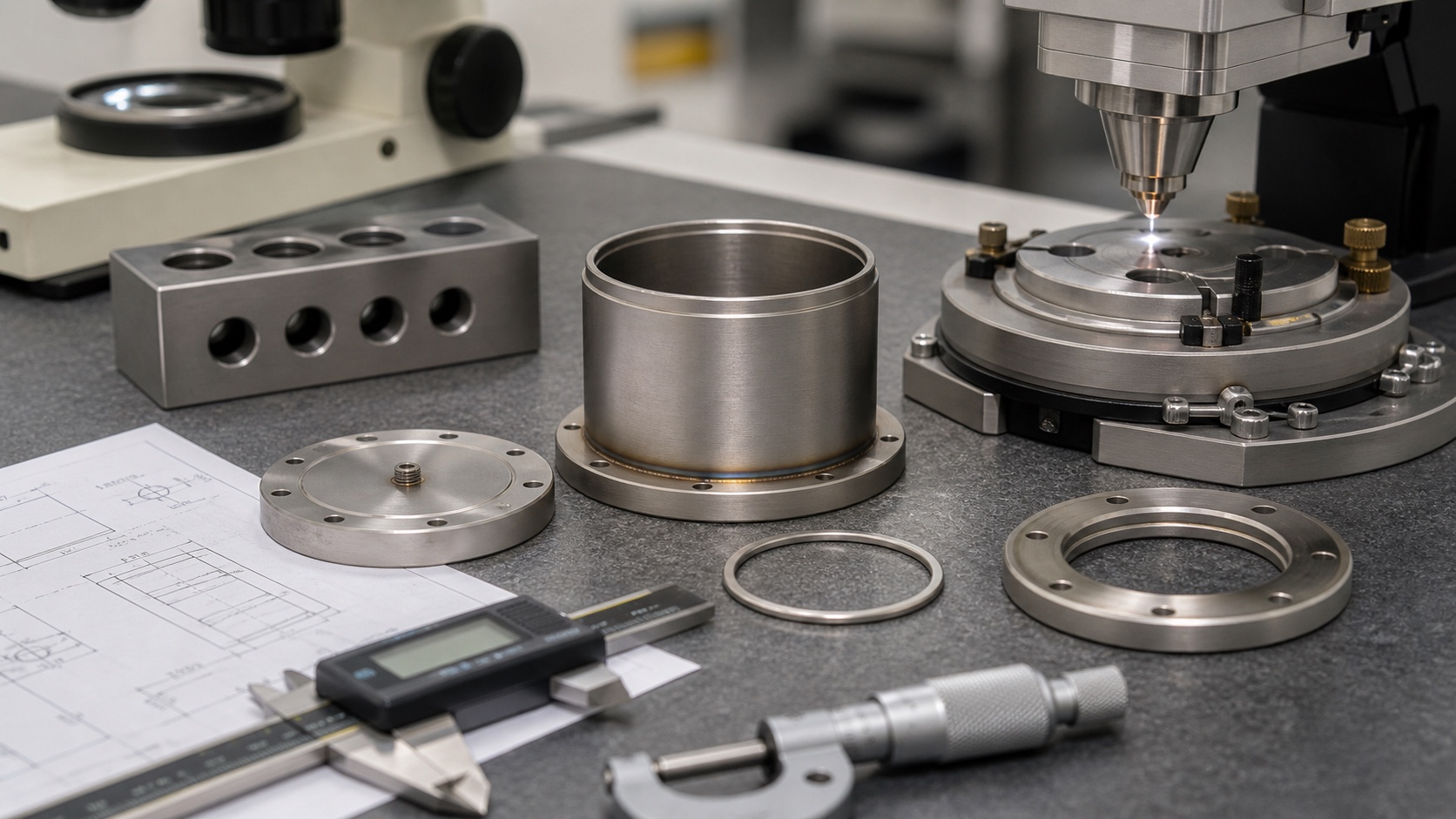
If you work in hermetic packaging, photonics, or high-reliability electronics, you already know Kovar by its most famous talent: it expands and contracts in lockstep with borosilicate glass and alumina ceramics. That property makes it invaluable for glass-to-metal and ceramic-to-metal seals. But when your design calls for a welded Kovar enclosure or feedthrough, a different question takes over — can Kovar be welded?
The short answer is yes, but with conditions. Kovar is not like welding 304 stainless steel. It demands clean surfaces, controlled heat input, and a clear understanding of its failure modes. As a precision machining partner that manufactures Kovar housings, lids, sealing rings, and flanges for exactly these applications, we've seen what works and what doesn't. This guide covers the full picture, from metallurgy to practical process parameters, so you can approach your next Kovar weld with confidence.
What Is Kovar? Composition and Key Properties
Kovar is a controlled-expansion iron-nickel-cobalt alloy. Its nominal composition is approximately 29% nickel, 17% cobalt, with the balance being iron, plus small additions of manganese and silicon (typically around 0.3% and 0.2%, respectively). It is specified under ASTM F15, and is also known by trade names such as Nilo K, Dilvar, and Pernifer. The material is a registered trademark, but "Kovar" has become the generic industry term.
The defining characteristic of Kovar is its low coefficient of thermal expansion (CTE). Between room temperature and about 400°C, Kovar expands at roughly 5.2 ppm/°C — a close match to borosilicate glasses like Pyrex and to certain alumina ceramics. This is what makes hermetic glass-to-metal sealing possible: when the assembly heats or cools, the metal and the glass move together instead of fighting each other and cracking.
Beyond CTE, a few physical properties matter for welding:
- Melting point: approximately 1450°C — similar to many steels, so standard fusion welding processes are thermally viable.
- Thermal conductivity: about 17 W/m·K at room temperature. That is low compared to copper or aluminum, which means heat tends to concentrate in the weld zone. That is useful for local melting, but it also raises the risk of overheating and distortion on thin sections.
- Electrical resistivity: around 49 µΩ·cm, which is high enough to affect resistance welding and electroplating behavior.
- Magnetic properties: Kovar is magnetic, which is relevant for some electron-beam and sputtering applications, though not for weldability itself.
We machine Kovar daily — turned housings, milled packages, thin-wall lids, and flanges — and the same qualities that make it tricky to machine (work hardening, burr formation, thin-wall deformation) also show up in welding. The material rewards patience and precision.
So, Can Kovar Be Welded?
Yes. Kovar is weldable, and successful welded Kovar components are produced every day in aerospace, medical devices, semiconductor equipment, and photonics. But it is not a forgiving material, and its weldability is generally considered lower than that of austenitic stainless steel.
Why? Two main reasons. First, Kovar is prone to hot cracking under restraint — the combination of its metallurgy and its thermal expansion behavior creates conditions where cracks propagate readily. Second, it forms a tenacious oxide at moderate temperatures, and that oxide can ruin a joint if it gets mixed into the molten pool.
That said, with the right process, shielding, and preparation, Kovar welds can be clean, strong, and vacuum-tight. In our experience supporting customers who build hermetic packages, the weld quality depends far less on the material itself and far more on three things:
- Cleanliness of the joint surfaces before welding.
- Joint design and fit-up.
- Heat input control during welding.
Get those right, and Kovar behaves well. Ignore them, and you'll chase porosity and cracks across every weld coupon.
The Main Challenges of Welding Kovar
Let's be direct: Kovar is not a beginner-friendly alloy. It has specific failure modes that will appear quickly if you treat it like plain steel. Here are the challenges we warn every customer about before they weld their first Kovar part.
Oxidation and Oxide Formation
Kovar forms a refractory, tightly adherent oxide at temperatures far below its melting point. This oxide is primarily a mixture of iron and nickel oxides (with cobalt oxides also present), and it does not simply burn off during welding. Instead, it can melt and become incorporated into the weld pool as inclusions, or it can remain at the joint interface as a brittle, non-metallic layer.
Either way, the result is a weak, porous weld. This is why shielding gas is not optional for Kovar — it is essential. For processes like TIG, you need an oxygen-free shielding gas on the front side and a backing gas on the root side. For laser welding, a well-directed cover gas prevents the weld surface from oxidizing immediately after the beam passes. And for anything truly critical, a vacuum or inert-atmosphere chamber eliminates the problem entirely.
Hot Cracking and Stress
The most common cause of weld failure in Kovar is hot cracking — specifically, liquation cracking in the heat-affected zone (HAZ). Kovar contains trace impurities and microsegregation at grain boundaries. When the HAZ heats rapidly, low-melting-point phases at those boundaries can melt, and if the joint is under tensile stress, the material separates along the weakened boundaries.
Add to that the fact that Kovar is often joined to dissimilar materials with different expansion rates. The differential thermal expansion between Kovar and, say, a copper lead frame generates significant residual stress as the weld cools. That stress can easily exceed the strength of a partially solidified grain boundary.
The practical countermeasures are preheating and controlled cooling. A moderate preheat (typically 150–300°C) reduces thermal gradients, and a slow, controlled cool-down gives the weld and HAZ time to relax. We also recommend designing fixtures to minimize restraint wherever possible — the more freedom the joint has to move, the lower the stress.
Contamination Sensitivity
If there is one rule we stress to our machining customers, it is this: Kovar is hypersensitive to contamination. Carbon, sulfur, and hydrogen are the enemies. They cause porosity, embrittlement, and cracking — often invisible until you leak-test or cross-section the joint.
Common contamination sources include:
- Machining oils and coolant residue
- Fingerprints (skin oils contain sulfur and salts)
- Residual flux from previous brazing or soldering steps
- Abrasive blasting media embedded in the surface
- Solvent residues that didn't fully evaporate
The fix is rigorous cleaning discipline. Solvent degreasing followed by alkaline cleaning and acid pickling is the standard sequence. And always handle cleaned parts with fresh gloves. We machine Kovar components to tight tolerances with a clean, controlled process, and we recommend our customers keep that same standard through to the weld station.
Thermal Expansion Mismatch with Dissimilar Metals
Kovar's low CTE is an asset when matching glass and ceramics, but a liability when welding to metals like copper, aluminum, or titanium. Copper expands at roughly 17 ppm/°C — more than three times Kovar's rate. Aluminum is worse. When you weld two such metals together, the interface experiences severe shear stress as the joint cools from solidus to room temperature.
For Kovar-to-titanium joints, in particular, research has demonstrated the value of composite interlayers placed between the two materials during electron beam welding. These interlayers accommodate the thermal expansion mismatch and prevent the formation of brittle intermetallic compounds at the fusion boundary. The takeaway: don't weld Kovar directly to a high-expansion metal and expect it to survive thermal cycling. Use an interlayer, a transition piece, or switch to brazing.
Best Welding Methods for Kovar
Not all welding processes are created equal for Kovar. Here is our practical rundown of the methods that work, the ones that are acceptable for limited cases, and the alternative you should always keep in mind.
Laser Welding (Nd:YAG, Fiber, and Diode Lasers)
Laser welding is the preferred method for Kovar in precision electronics and hermetic packaging, and it is the process we recommend most often to customers building laser diode modules, microwave packages, and MEMS enclosures.
The advantages are compelling: a tightly focused beam delivers intense heat exactly where you need it, the HAZ is narrow, and the short weld times minimize oxide formation. Pulsed Nd:YAG lasers at 1064 nm, fiber lasers, and diode lasers all work well with Kovar because the material absorbs the near-infrared wavelength efficiently.
Research on laser welding of Kovar has shown good linear relationships between pulse parameters and weld dimensions — increasing pulse energy increases penetration depth and weld spot width in a predictable way. That predictably makes it possible to dial in a specific weld profile for a given joint geometry.
Our recommended starting point for Kovar laser welding is a power density in the range of ~10⁵ W/cm². This is sufficient to melt the material completely without transitioning into violent keyhole vaporization, which can eject material and create porosity. Pulse durations typically fall between 1 and 10 ms, depending on the material thickness.
TIG Welding (GTAW)
Tungsten inert gas welding is suitable for thicker Kovar sections where a laser lacks the total heat input, or where the capital cost of a laser system isn't justified. TIG gives you good control over the weld pool, and with a clean joint and proper shielding, it can produce sound welds.
The critical decisions are filler metal and shielding. Use matching Kovar filler (such as a K-1 or Kovar-compatible rod) or a high-nickel filler — not standard stainless steel filler, which introduces chromium and other elements that alter the joint's expansion characteristics and create brittle phases. Shielding should be argon or helium with a trailing shield, and you need backing gas on the root side to prevent oxidation on the back of the weld.
The downside of TIG is the high heat input compared to laser. On thin Kovar packages (lids and caps under 0.5 mm), TIG will often cause distortion and excessive HAZ growth. For those applications, laser is the better answer.
Electron Beam Welding (EBW)
Electron beam welding offers two enormous advantages for Kovar: deep penetration with a very narrow HAZ, and a vacuum environment that eliminates oxidation entirely. It is the process of choice for high-reliability Kovar-to-titanium assemblies, where composite interlayers are used to manage thermal expansion mismatch and prevent brittle intermetallic formation.
EBW also excels in hermetic sealing applications that demand a weld with no oxide inclusions and no atmospheric porosity. The vacuum chamber acts as both the shielding environment and the cleanliness barrier.
The trade-offs are real, though. Electron beam welders are expensive, the vacuum chamber limits part size, and setup is slower than a laser weld cell. For most production Kovar components, EBW is overkill — but for classified aerospace hardware or mission-critical medical devices, it's often the safest choice.
Resistance Welding and Spot Welding
Resistance welding — including spot welding — has a place in Kovar assembly, but a limited one. It is useful for tacking small components into position before a final laser or TIG weld, and for non-hermetic joints where shallow penetration is acceptable.
The limitations are significant. Penetration is shallow, electrode contamination can be a problem because Kovar's oxide adheres to copper electrodes, and the process produces a very small weld nugget that cannot guarantee hermeticity. We recommend resistance welding only as a pre-weld tack method or for mechanically stable, non-sealed joints. If your application requires a vacuum-tight seal, plan on a fusion weld process.
Brazing as an Alternative to Welding
Sometimes the right answer is not welding at all. Brazing — with copper, silver-copper, or gold-tin fillers — is frequently chosen over welding for Kovar-to-glass and Kovar-to-ceramic seal assemblies. The reason is thermal cycle control. Brazing happens at a lower temperature than fusion welding, which means less residual stress on the glass or ceramic and a reduced risk of compromising the hermetic seal.
Recent process developments, including laser-assisted brazing and dual-source vacuum brazing, have improved the reliability of Kovar-copper composite joints for high-power electronics. In our experience, the decision between brazing and welding comes down to joint geometry and service requirements. Brazing is gentler and often yields better results when a glass or ceramic seal sits nearby; welding provides a stronger, all-metal joint where no such sensitivity exists.
Pre-Weld Preparation and Joint Design
Here is a sentence we repeat to every engineer who calls us about Kovar problems: the difference between a good weld and a failed weld is often on the bench, not the torch. Preparation is not a supporting step. It is the main event.
Cleaning and Surface Preparation
A proper Kovar cleaning sequence looks like this:
- Solvent degreasing to remove oils and machining residues. Acetone or isopropyl alcohol followed by a clean rinse works well.
- Alkaline cleaning to saponify any remaining organic contamination.
- Acid pickling to remove the surface oxide layer. A dilute hydrochloric or nitric acid pickle is commonly used, followed by a thorough rinse.
- Deionized water rinse and clean drying. Never let parts air-dry with standing water spots, as mineral deposits can contaminate the weld.
One caution: avoid abrasive blasting as a cleaning method. It can embed alumina or silica particles into the Kovar surface, and those particles will show up as inclusions in the weld. If you must mechanically clean, use a clean, non-metallic abrasive and follow with a full acid pickle.
Verify cleanliness with a simple water-break test. Clean Kovar will hold a continuous film of water; contaminated areas will cause the water to bead up and pull away.
Joint Types and Fit-Up
For hermetic packages, the standard joint configurations are the lap joint, the butt joint, and the step joint. Each has a role:
- Lap joints are the easiest to weld because they tolerate slight fit-up variation and provide a natural path for the weld to bridge. They are common for Kovar lid-to-frame sealing.
- Butt joints give the cleanest cosmetic result and the least material mismatch, but they demand excellent fit-up and precise beam placement.
- Step joints are the workhorse of hermetic sealing — the lid sits into a recessed step in the frame, providing self-fixturing and a controlled weld depth. This configuration is ideal for laser welding.
Fit-up matters enormously. We recommend a clearance of 0.001 to 0.003 inches for most Kovar welding applications. Gaps larger than that invite porosity because the weld pool has to bridge empty space, and they concentrate stress at the root of the joint. Gaps smaller than that can trap air and cause outgassing during the weld.
Joint geometry also governs stress concentration. Sharp corners and abrupt thickness changes act as stress risers where cracks initiate. Design transitions that are as gradual as the package allows, and place the weld seam away from any high-stress regions if possible.
Fixturing and Heat Sinking
Rigid fixturing serves two purposes: it holds the joint in precise alignment, and it controls heat flow. We recommend fixtures made of low-thermal-conductivity materials like stainless steel or ceramic, which hold parts firmly without acting as a giant heat sink that pulls heat away from the weld zone.
For assemblies with nearby glass or ceramic seals, heat sinks are essential. A copper or aluminum heat sink placed strategically behind the weld zone will drain excess heat and protect the fragile seal from thermal damage. Just be careful not to cool the weld itself too aggressively — that induces the same thermal shock you are trying to avoid.
Finally, consider vacuum baking — before welding and after. A pre-weld vacuum bake at 300–400°C drives absorbed gases and moisture out of the Kovar, reducing the risk of porosity. A post-weld bake serves the same purpose for the finished assembly and helps verify that the joint can hold vacuum. For hermetic applications, this step is not optional.
Laser Welding Kovar: Parameters and Best Practices
Because laser welding is the dominant process for modern Kovar packages, it deserves a deeper look. Here is how we think about laser parameters, shielding, and process control.
Choosing the Right Laser Wavelength and Pulse Mode
Kovar absorbs near-infrared wavelengths well, which makes pulsed Nd:YAG (1064 nm), fiber lasers, and diode lasers all practical choices. The differences come down to spot size and pulse shape:
- Pulsed Nd:YAG delivers a controlled pulse of energy that is ideal for seam welding thin Kovar packages. The pulse can be shaped to ramp up slowly, reducing spatter and cracking.
- Fiber lasers offer excellent beam quality and smaller spot sizes, which translates to a narrower HAZ. They run well in both pulsed and CW modes.
- Diode lasers produce a broader, flatter beam profile, useful for larger-area surface melting but less suited for deep penetration welds.
For thin Kovar — the kind used in lids and package walls — pulsed mode is almost always preferred over CW. The reason is heat input control. A pulsed beam lets the material cool slightly between pulses, limiting the buildup of heat in the surrounding metal. Continuous wave operation, by contrast, keeps adding heat and can quickly overheat thin sections, causing blow-through and distortion.
Power Density, Pulse Duration, and Focus Position
A practical starting envelope for pulsed laser welding of Kovar is:
- Peak power density: around 10⁵ W/cm²
- Pulse duration: 1–10 ms, depending on material thickness
- Focal position: at or slightly above the surface for thin materials; slightly below the surface for thicker joints
There is an inherent trade-off between penetration depth and spot width. Higher power density drives deeper penetration but also risks keyhole collapse and porosity. Lower power density produces a wider, shallower weld that looks smooth but may not achieve full joint penetration.
The trick is to optimize the aspect ratio — the ratio of weld depth to width — for your joint. For hermetic sealing of thin-walled Kovar packages, an aspect ratio of about 1:1 to 1.5:1 works well. This gives a stable, crack-resistant weld nugget without creating a deep, narrow keyhole that is vulnerable to porosity.
Research on pulsed laser welding of Kovar has confirmed that weld dimensions respond predictably to pulse parameters — pulse energy correlates nearly linearly with penetration depth, and pulse duration affects weld width. Use that linearity. Run a DOE on coupons, measure cross-sections, and build your process window on data rather than guesswork.
Shielding and Cover Gas Requirements
Shielding gas for laser welding serves a different role than in TIG. The weld is fast, so the gas primarily needs to displace air above the melt pool and protect the solidifying weld surface. Argon is the standard choice — it is dense, inert, and affordable. Helium offers better heat transfer and higher ionization potential, which can be useful at higher powers. Nitrogen works for some applications, but it can react with the alloy at elevated temperatures, so we do not recommend it for hermetic joints.
Flow rate and nozzle placement matter more than people think. Excessive gas flow creates turbulence that entangles air into the weld pool, causing porosity. We recommend a laminar flow with a rate in the range of 5–15 L/min, directed at a shallow angle behind the laser beam, covering the molten zone until it solidifies.
For hermetic sealing, the choice between conduction welding and keyhole welding is also governed by shielding requirements. Conduction welding — where the beam melts a shallow pool without vaporization — produces a smooth surface and is far more forgiving of shielding imperfections. Keyhole welding achieves deeper penetration but creates a violent, transient cavity that is more sensitive to gas entrapment and oxidation. For Kovar lids and thin-wall packages, conduction welding is the safer default.
Common Welding Defects in Kovar and How to Prevent Them
Even experienced welding engineers encounter defects on Kovar. Here is a troubleshooting guide drawn from real production experience — what causes each problem, and how to stop it.
Porosity
Causes: Moisture on the surface, hydrocarbon contamination, or shielding gas entrainment. Kovar outgasses hydrogen and other gases if it has absorbed them during prior processing.
Prevention: Vacuum bake the parts before welding. Ensure the shielding gas is dry and delivered without turbulence. Verify that cleaning solvents have fully evaporated — trapped solvent in a lap joint is a guaranteed pore. And use clean filler material if you are adding any.
Cracking (Hot and Cold)
Causes: Restraint from rigid fixturing or joint geometry, rapid cooling, and microsegregation of impurities at grain boundaries. Hot cracking appears along the centerline of the weld or in the HAZ; cold cracking appears later, often during handling or thermal cycling.
Prevention: Preheat to 150–300°C on thicker sections or restrained joints. Slow the cooling rate with a controlled ramp-down after welding. Use low-restraint fixtures that allow controlled contraction. And select a matching filler that compensates for the base metal's composition.
Oxide Inclusions and Discoloration
Causes: Inadequate shielding gas coverage or post-weld oxidation at elevated temperature. Discoloration around the weld bead — blue, purple, or gray — is a visual signal that the cover gas failed to protect the surface.
Prevention: Use trailing shields for TIG, proper nozzle placement for laser, and purge chambers for high-integrity work. If discoloration appears, it must be removed — mechanically or chemically — before the part goes to leak testing or plating.
Distortion and Warpage
Causes: Uneven heating, thin sections, and excess energy input. Kovar's relatively low thermal conductivity means heat does not spread away quickly, so the weld zone heats and expands locally while the surrounding material stays cool, causing distortion.
Prevention: Balance the joint design so the weld seam is centered and symmetrical. Use pulse shaping — a ramp-down at the end of each pulse reduces the thermal shock. Integrate heat sinks to pull excess heat away from the weld zone without quenching it. And consider welding from both sides in a symmetric sequence where possible.
Applications of Kovar Welding
Kovar welding is not a lab curiosity — it is a production reality in industries where reliability is non-negotiable. Here is where we see it most.
Hermetic Sealing of Electronic Packages
Crystal oscillators, MEMS sensors, and microwave components all rely on hermetic packages to protect their internals from moisture and contamination. Kovar is the default material for these packages precisely because it matches the expansion of the glass and ceramic feedthroughs that carry electrical signals through the package wall. Welding the Kovar lid to the Kovar frame creates the final seal, often with a laser weld around the perimeter. The weld must be vacuum-tight, crack-free, and thermally stable across the device's operating range.
Photonic and Laser Diode Packaging
In high-power laser diode modules — such as 980 nm pump lasers for fiber amplifiers — the optical components are mounted on Kovar carriers with CTE-matched solders, and the package is hermetically sealed by welding a Kovar lid or window flange. Research on such modules has demonstrated that laser welding is the enabling process: the narrow HAZ prevents thermal damage to sensitive optical components, and the precision of beam placement allows seams to run within millimeters of the active device.
Aerospace and Defense Components
Connectors, feedthroughs, and sensors on aircraft, satellites, and missiles must survive extreme thermal cycling and vibration. Kovar's expansion match to the glass seals inside these components keeps the seals intact over decades of service. Welded Kovar enclosures protect radar modules, RF amplifiers, and navigation electronics. For these applications, weld quality is verified rigorously with helium leak testing, x-ray inspection, and thermal cycling.
Medical and Scientific Instruments
X-ray tubes and vacuum instruments depend on Kovar for their vacuum-tight envelopes. The material's low thermal expansion ensures that glass-to-metal seals remain intact through the high temperatures of X-ray tube operation. Welded Kovar assemblies form the structural and vacuum boundary of these devices, and the joints must hold ultra-high vacuum for the life of the instrument.
Kovar vs. Stainless Steel and Other Weldable Alloys
If you are considering whether Kovar is the right material for your application — or why it behaves differently from what you are used to — this comparison helps. Here is how Kovar stacks up against stainless steel, Alloy 46, and Invar.
| Material | Weldability | CTE (ppm/°C) | Typical Applications |
|----------|-------------|--------------|----------------------|
| Kovar (ASTM F15) | Fair to good with controlled parameters; cracking-sensitive at high restraint | ~5.2 | Hermetic packages, glass-to-metal seals, photonics, aerospace feedthroughs |
| Stainless Steel 304 | Excellent; forgiving, easy to weld | ~17 | General enclosures, structural components, non-hermetic housings |
| Alloy 46 | Fair; similar cracking sensitivity to Kovar | ~7.8 | Sealing to soda-lime glass, low-expansion lead frames |
| Invar (Alloy 36) | Poor to fair; prone to hot cracking and difficult to weld | ~1.2 | Ultra-low-expansion structures, precision cavities, shadow masks |
The takeaway: if your application does not require a low CTE match to glass or ceramic, stainless steel is the easier material. But if you need hermeticity to glass feedthroughs, there is no real substitute for Kovar. The welding difficulty is the price you pay for the thermal performance.
Frequently Asked Questions About Welding Kovar
Is Kovar hard to weld?
It is weldable, but more challenging than stainless steel. The two main difficulties are its sensitivity to oxidation and its susceptibility to hot cracking under restraint. With clean parts, proper shielding, and controlled heat input, Kovar welds reliably. Without those controls, it fails consistently.
Can Kovar be welded to stainless steel?
Yes. Laser welding and electron beam welding are the most reliable methods for Kovar-to-stainless-steel joints. Use a nickel-based filler to accommodate the composition differences, and control heat input carefully to prevent cracking. A buttering layer of nickel alloy on the Kovar side is a good technique in production.
What filler metal do you use for Kovar?
The options are a matching Kovar filler (essentially the same composition as the base metal), or a nickel-based filler such as Ni-1. Avoid standard stainless steel fillers — they introduce alloying elements that shift the expansion characteristics and promote brittle phase formation. For autogenous laser welds, no filler is used at all, and the joint is designed to fuse directly.
Can Kovar be welded to copper?
Direct welding is problematic because of the large thermal expansion mismatch. Copper expands roughly three times more than Kovar, so the joint will experience severe stress during cooling and thermal cycling. The better approaches are brazing with copper or silver-copper fillers, or using an interlayer material that gradually transitions the expansion coefficient. Laser welding with a nickel or molybdenum interlayer is sometimes used for specialized applications.
Is brazing better than welding Kovar?
It depends on the application. Brazing is gentler — it operates at lower temperatures and induces less stress, which makes it the preferred choice when glass or ceramic seals are nearby. Welding produces a stronger all-metal joint but with more heat input and stress. For hermetic Kovar-glass assemblies, brazing is often safer. For all-metal Kovar packages, laser welding is cleaner and faster.
Does Kovar require preheating before welding?
Not always, but often beneficial. For thin sections and low-restraint joints, preheating is unnecessary. For thicker sections, restrictive joint geometries, or dissimilar-metal joints, a moderate preheat of 150–300°C reduces thermal gradients and cracking risk. Waterfall testing on coupons is the best way to determine whether your joint actually needs preheat.
Conclusion and Key Takeaways
So, can Kovar be welded? Yes — and it is welded successfully every day in demanding industries. But the honest answer is that Kovar demands respect. You cannot approach it with the casual confidence you might have with 304 stainless steel. You need:
- Rigorous cleanliness — solvent degrease, acid pickle, and clean gloves are non-negotiable.
- The right process — laser welding and electron beam welding are the top choices; TIG works for thicker sections; brazing is often the better answer when glass or ceramic is involved.
- Controlled heat input — use power densities around 10⁵ W/cm² for laser welding, keep pulses in the 1–10 ms range, and consider preheating for restrained joints.
- Proper shielding — argon or helium, delivered with laminar flow, protects the weld from oxidation.
- Sound joint design — tight fit-up (0
RFQ Support
Send Your Kovar Machining RFQ
Share drawings, CAD files, material requirements, quantities, tolerances, finishing needs, inspection requirements, and your target timeline. Our team will review the details and respond by email.
Helpful RFQ details
- 2D drawings or 3D CAD files
- Material: Kovar / ASTM F15 / Fe-Ni-Co alloy
- Quantity, tolerance, finish, inspection needs
- Application and purchasing timeline
Direct email: info@kovarmachining.com