Can Kovar Be Plated? A Complete Guide to Kovar Plating Processes, Adhesion, and Applications
Can Kovar Be Plated? Yes—Here's How to Get It Right (Processes, Challenges & Applications)
If you work with hermetic packaging, RF connectors, or glass-to-metal seal components, you've likely stared at a drawing callout and asked the same question: Can Kovar be plated?
The short answer is yes. Kovar is plated every day in production facilities around the world—usually with nickel, gold, silver, or tin. But the honest engineering answer is messier. Kovar is notoriously sensitive to surface preparation, and a rushed or generic plating process will fail. I've seen it happen: blistering after solder reflow, peeling during thermal cycling, and crazed gold surfaces that looked beautiful under a microscope and delaminated on the first temperature shock.
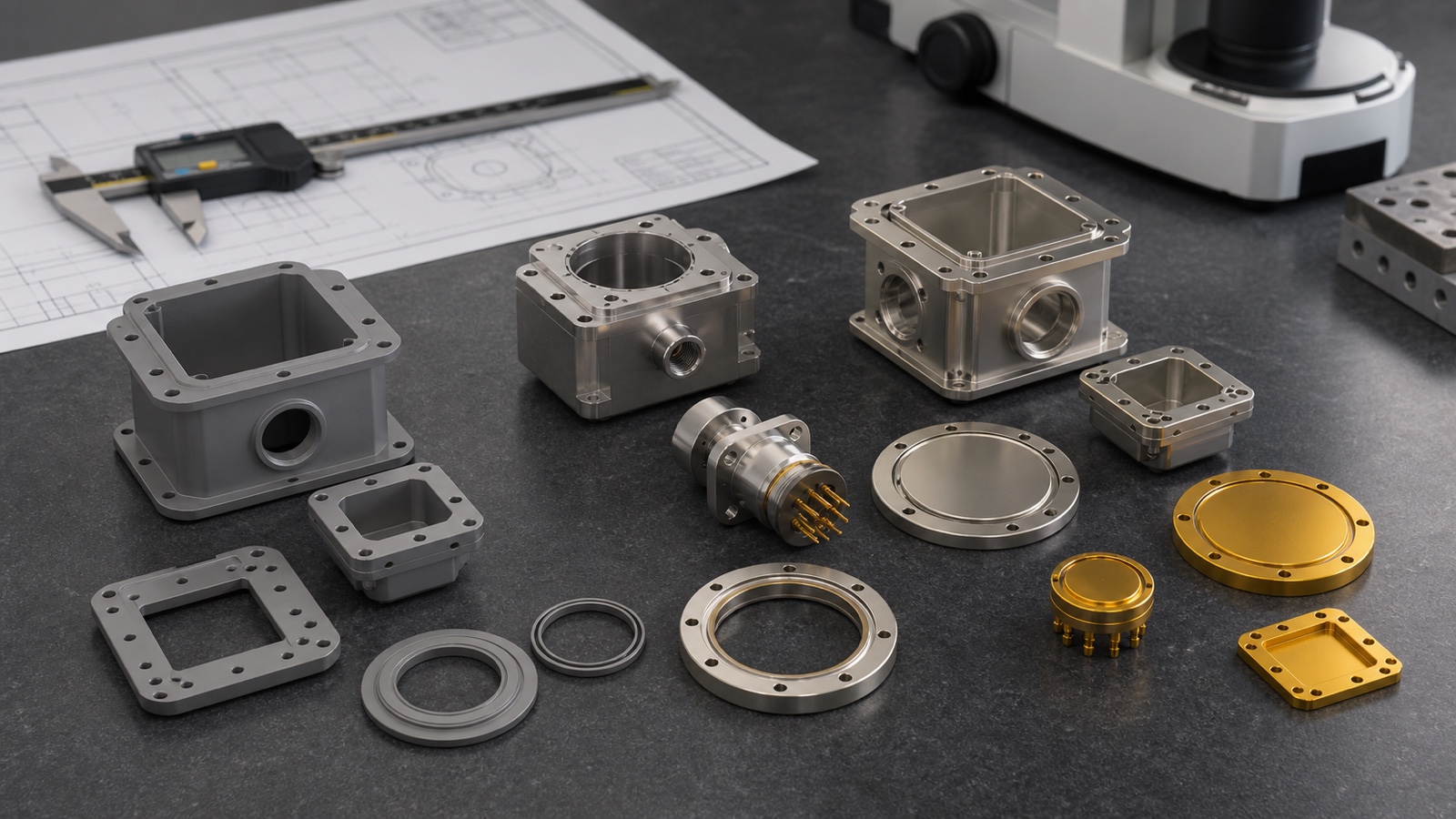
At KELTRYN, we machine Kovar components daily—housings, lids, flanges, sealing rings, and thin-wall frames destined for hermetic and high-reliability applications. Plating is often the step that comes after our parts leave the shop, and it's the step that determines whether a $500 part becomes a $5,000 scrap pile. This guide is the resource I wish our customers had before they sent their first Kovar batch to a plater.
Let's dig into the metallurgy, the processes, the failure modes, and the specifications that separate a reliable plated Kovar component from a latent field failure.
What Is Kovar and Why Does It Need Plating?
Kovar is a controlled-expansion alloy typically composed of approximately 29% nickel, 17% cobalt, and the balance iron, with small amounts of manganese and silicon. Its defining characteristic is a low coefficient of thermal expansion (CTE)—roughly 5.2 to 5.9 ppm/°C over the range of about 20°C to 200°C, depending on heat treatment and exact composition. That coefficient is deliberately engineered to match borosilicate glasses and alumina ceramics used in hermetic sealing.
This CTE match is why Kovar exists. When you seal a metal lead or housing to a glass or ceramic body, the two materials must expand and contract at nearly the same rate during the sealing process and throughout the device's service life. If the CTE mismatch is too large, the glass cracks, the seal leaks, or the metal pulls away from the dielectric. Kovar's iron-nickel-cobalt formulation makes it the default choice for glass-to-metal seals, transistor bases, diode packages, hermetic connectors, microwave feedthroughs, and a host of semiconductor packaging applications.
To answer a common question from people discovering this material for the first time: What type of metal is Kovar? It is a superalloy—specifically, a controlled-expansion iron-nickel-cobalt alloy. It is not a precious metal. Kovar is sometimes confused with stainless steel or Invar, but it is its own material class, standardized under ASTM F15, SAE AMS 7726, and similar specifications. It's magnetic, machinable, weldable, and brazable, but it is not corrosion-resistant in the way that, say, 304 stainless is.
So why plate it at all?
Because bare Kovar is a problematic surface in real-world operating environments. Here's what happens:
- Oxidation: Kovar forms tightly adherent surface oxides—oxides of chromium, cobalt, nickel, and iron. These oxides darken the surface, degrade solderability, and act as a barrier to electrical contact.
- Poor solderability: Bare Kovar does not wet well with common solders. Oxide films and the alloy's inherent surface chemistry prevent reliable solder joints.
- Corrosion: In humid or salt-laden environments, uncoated Kovar can corrode, compromising hermeticity and increasing contact resistance.
- Electrical conductivity: Kovar's bulk electrical conductivity is poor compared to copper or gold. Plating with a conductive metal reduces resistance on contact surfaces.
Plating addresses all of these. A well-plated Kovar component gains a consistent, oxide-free surface for soldering, a corrosion barrier, stable electrical contact, and—when the plating is gold—a reliable bonding surface for wire bonding and high-frequency applications.
The Short Answer: Yes, Kovar Can Be Plated
Let me state it plainly: Kovar is absolutely electroplateable, and plating on Kovar is a standard, well-understood industrial process. Aerospace, defense, medical, and telecommunications manufacturers have plated millions of Kovar components over the past several decades.
The real challenge isn't whether Kovar can be plated. It's whether the Kovar surface has been prepared correctly to achieve and maintain adhesion through subsequent thermal exposure.
Kovar's surface oxides are the culprit. When exposed to air—especially after heat treatment, brazing, or glass sealing—Kovar forms a mixed oxide layer that is unusually tenacious. Standard acid pickling solutions that work fine on steel or copper simply don't dissolve these oxides reliably. If the oxides remain, the electroplated deposit sits on top of a weak boundary layer. The part looks fine coming out of the tank. It fails later—during solder reflow, thermal cycling, or even just months of service.
That's the failure mode that gives Kovar its reputation as a "hard-to-plate" metal. But with the right activation sequence and a nickel strike, the adhesion problem disappears. In production, the process is routine.
Kovar can be plated with a variety of metals:
- Nickel for undercoats, diffusion barriers, and corrosion resistance
- Gold for high-reliability contacts, solderability, and corrosion protection
- Silver for high-conductivity and brazing applications
- Copper for improved electrical and thermal conductivity, and as a solderable underlayer
- Tin for solderability and mild corrosion protection
- Tin-lead or other solder alloys in some legacy applications
These finishes are applied using two primary production approaches:
Rack plating is used for larger or fragile components—Kovar housings, flanges, and precision-machined bodies. Parts are fixtured on conductive racks, Which ensures uniform current distribution and controlled deposit thickness.
Barrel plating is used for small, robust parts like Kovar pins, leads, and eyelets. Parts tumble in a rotating barrel, which allows bulk processing at lower cost—though with less precise thickness control than rack plating.
The choice depends on part geometry, tolerances, and the plating specification, but both approaches are proven with Kovar.
Most Common Kovar Plating Processes and Finishes
The plating stack on Kovar is rarely a single layer. Almost every serious application uses a sequence designed to protect the base alloy and provide a functional outer surface.
Nickel Plating on Kovar
Nickel is the workhorse finish for Kovar. It serves three roles:
- An adhesion layer. A thin nickel strike—usually a Wood's nickel strike—bonds to the activated Kovar surface and provides a base for subsequent deposits.
- A diffusion barrier. Nickel prevents the interdiffusion of gold or silver into the Kovar substrate at elevated temperatures, which would otherwise degrade the conductive finish and cause porosity.
- A corrosion-resistant final finish. In applications that don't require precious-metal surfaces, a thicker sulfamate nickel deposit provides a hard, reasonably corrosion-resistant coating.
The thickness of nickel plating on Kovar ranges from a 0.05 to 0.1 mil strike (about 50 to 100 microinches) to several mils for industrial components. For aerospace and hermetic applications, nickel undercoats are typically 100 to 200 microinches before a noble metal finish is applied.
Gold Plating on Kovar
Gold plating is the standard for high-reliability Kovar components. It offers:
- Excellent solderability
- Low and stable contact resistance
- Corrosion resistance in harsh environments
- Wire bondability (gold or aluminum wire)
- Resistance to oxidation, even at elevated temperatures
Gold is almost never plated directly onto bare Kovar. The standard stack is: activated Kovar → Wood's nickel strike → sulfamate nickel barrier layer → gold flash.
The gold layer itself is typically 30 to 100 microinches thick for solderable surfaces, and sometimes more for wear-resistant contact areas. On Kovar lids used for hermetic sealing, a common specification is 50 microinches of gold over 100 to 200 microinches of nickel.
One caution: on high-temperature applications, a pure gold deposit can diffuse into the nickel underlayer if the gold is too thin or the temperature is high enough. The nickel barrier slows this. That's why the nickel undercoat is non-negotiable for Kovar destined for high-temperature service.
Silver Plating on Kovar
Silver plating is chosen when electrical or thermal conductivity is the top priority, or when the component will be brazed at elevated temperatures. Silver provides:
- The highest electrical conductivity of any plated metal
- Excellent thermal conductivity
- Good lubricity for sliding contacts
- Compatibility with silver brazing processes
Silver-plated Kovar is common in high-power RF components, waveguide hardware, and feedthroughs that require brazing into ceramic assemblies.
The downside: silver tarnishes in sulfur-containing atmospheres and is prone to dendritic growth and migration under humid, voltage-biased conditions. For those reasons, silver-plated Kovar is usually specified with a nickel underlayer and sometimes a thin gold flash for shelf-life protection.
Copper and Tin Plating on Kovar
Copper plating on Kovar is used when you need enhanced electrical or thermal conductivity beneath a solderable finish. It's also used as a thick, ductile underlayer in some hermetic package designs. Copper is easier to solder than nickel, which is why you'll often see copper flash between the nickel barrier and the final finish in solderability-critical applications.
Tin plating is a lower-cost option for Kovar leads and terminals where corrosion resistance requirements are modest and solderability is the main concern. Tin provides a bright, solderable surface, but it has a low melting point (about 232°C) and is not suitable for high-temperature service. Tin also risks the growth of tin whiskers, so its use is carefully controlled in aerospace applications.
The Typical Plating Sequence
A production-grade Kovar plating process follows a predictable sequence:
- Degreasing and pre-cleaning to remove oils, fingerprints, and particulate contamination
- Electrolytic cleaning in an alkaline solution with periodic reverse current to lift residual soils
- Acid activation to remove and/or condition surface oxides
- Wood's nickel strike (a high-chloride, high-acid nickel bath) to deposit a thin, adherent nickel layer
- Main plating—thicker nickel, copper, gold, or silver depending on the specification
- Rinsing and drying
- Post-plate heat treatment if required for hydrogen embrittlement relief or adhesion verification
The thickness and composition of the final finish vary widely. Microelectronics call for microinch-level deposits—30 to 100 microinches of gold, for example. Industrial components might receive several mils of nickel for wear resistance or build-up for dimensional compensation.
Kovar Plating Challenges: Adhesion, Oxidation, and Fixes
The number-one problem across the industry is poor adhesion—blistering, peeling, or crazing of electrodeposited coatings on Kovar. It's so common that experienced platers treat Kovar differently from almost any other substrate.
Why Kovar Is Hard to Plate
Kovar's surface forms tightly adherent oxides of chromium, cobalt, nickel, and iron. These oxides are not just a thin, passive film. They can be mechanically tough, chemically resistant, and thermally stable. Ordinary acid pickling—the kind that quickly cleans steel—may only partially remove them, leaving a microscopic oxide layer even when the part looks bright.
The problem is compounded by heat treatments. Kovar components that have been brazed, annealed, or glass-sealed develop a thick, dark oxide scale that must be completely removed—typically by abrasive blasting, acid cleaning, or a combination—before any plating can be considered.
The Classic Failure Mode
Here's how it plays out:
A Kovar part is fabricated, cleaned half-heartedly, and plated directly with gold or nickel. The deposit covers the surface, and the part passes a visual inspection. Then the component goes through solder reflow at 250°C or thermal cycling from -55°C to +125°C. The differential thermal expansion between the deposit and the substrate, combined with the weak oxide interface, causes the plating to lift. You see:
- Blistering: small bumps where the deposit has separated from the substrate
- Peeling: large areas of coating lifting at edges and corners
- Crazing: fine cracks in the deposit, often visible only under magnification
- Black or dark spots: where the underlying oxide shows through pinholes after reflow
In severe cases, the coating separates completely, taking the solder joint—and the electrical connection—with it.
Proven Fixes Used by Commercial Platers
The good news is that these failures are preventable. The best commercial platers follow a strict, proven sequence:
1. Bi-polar electro-cleaning and activation
Instead of a simple acid dip, experienced platers use a periodic reverse current (bi-polar) electro-cleaning step in an alkaline cleaner, followed by activation in an acid chloride solution. The alternating current helps mechanically loosen oxide and smut from the surface, while the acid chloride dissolves residual oxides efficiently.
2. Wood's nickel strike as a mandatory first layer
This is the single most important step. A Wood's nickel strike—named for its developer, not the forest—is a high-chloride, high-acid nickel bath operated at high current density for a short time (typically 1 to 3 minutes). It deposits a thin, extremely adherent nickel layer while aggressively etching the Kovar surface. The result is a metallic-to-metallic bond rather than a deposit sitting on an oxide.
If a plater tells you they don't use a nickel strike on Kovar, find another plater.
3. Sulfamate nickel baths with controlled parameters
For the main nickel deposit, a sulfamate nickel bath operated at controlled current density, temperature, and pH produces a low-stress, ductile deposit. This matters because residual stress in the deposit contributes to poor adhesion and crazing during thermal cycling. A well-run sulfamate bath minimizes that risk.
4. Ultrasonic cleaning and hydrogen embrittlement relief baking
Ultrasonic cleaning ensures that blind holes, threads, and crevices—common features on machined Kovar components—are free of soils and solutions. And after plating, a baking step (typically 190°C to 220°C for several hours) relieves hydrogen embrittlement that can weaken thin-section Kovar parts.
The Surface Activation Step Matters More Than the Bath
I want to emphasize this because it's the root of most Kovar plating problems: the activation step matters more than the plating bath chemistry. A perfect gold bath will fail on a poorly activated Kovar surface. A mediocre nickel bath will succeed on a perfectly activated surface.
The practical rules from industry forums and experienced plating shops are simple:
- Keep the part wet. Between activation and plating, the Kovar surface must never be allowed to dry. Drying re-oxidizes the surface and destroys the activation work.
- Minimize transfer time. Move parts from the activation tank to the strike tank as quickly as possible.
- Control bath contamination. Nickel baths are sensitive to organic contaminants, copper drag-in, and iron accumulation. Regular carbon treatment and dummy plating keep the bath healthy.
- Use freshly mixed activation solutions. Old, depleted acid baths lose their effectiveness.
If your plating vendor follows these rules—and verifies adhesion with thermal shock—your Kovar components will perform reliably.
Kovar Plating Specifications and Quality Control
Plating on Kovar is rarely a "make it shiny" task. For hermetic, aerospace, medical, and defense applications, plating is governed by strict military and industry specifications. If you're sourcing plated Kovar components, you should see these documents referenced on your drawings and certs.
Common Specifications
- AMS 2424: Gold plating for engineering applications. Covers thickness, adhesion, and quality requirements for gold deposits.
- AMS 2404: Nickel plating—often specified for electrodeposited nickel on Kovar and other alloys.
- QQ-N-290: Federal specification for nickel plating (electrodeposited), still widely referenced in defense and aerospace drawings.
- MIL-DTL-45204: Military specification for electrodeposited gold plating—the standard for high-reliability gold finishes.
- ASTM B488: Standard specification for electrodeposited gold coatings—thickness, hardness, and adhesion requirements.
- ASTM B689 / B734: Relevant standards for tin and other finishes.
- AMS 2414 and AMS 2411: Silver and copper plating specifications, depending on the finish.
Test Methods You Should Expect
A reliable Kovar plater will not just dip parts and ship them. The following tests are standard for aerospace and hermetic applications:
- Solderability testing: A sample is fluxed, dipped in solder at a controlled temperature, and inspected for complete wetting with no dewetting or non-wetting. This is critical for Kovar leads and terminals.
- Thermal shock testing: The plated part is heated to a specified temperature and quenched—often from 150°C to room temperature, or through multiple cycles—to verify the plating doesn't blister, peel, or craze.
- Bend tests for adhesion: A plated test strip is bent over a mandrel (or to a specific angle) and inspected for cracking or flaking of the deposit. A poorly prepared Kovar surface fails this test visibly.
- Salt spray (corrosion) testing: Plated samples are exposed to a salt fog for a specified duration to confirm the coating provides adequate corrosion protection.
- Thickness verification by XRF: X-ray fluorescence is used to measure the thickness of each plated layer—nickel undercoat, gold topcoat—without destroying the part. This is the standard method for plated Kovar components.
The Role of Analytical Lab Services
Behind every reliable plating process is a functioning analytical lab. The plating bath must be monitored and controlled:
- Nickel chloride, nickel sulfamate, and boric acid concentrations must be within the operating window for the strike and main nickel baths.
- Hull cell testing is used to evaluate the bath's performance—covering power, current density range, and deposit appearance—before production runs.
- Deposit impurity analysis via ICP or other methods detects contamination in the bath that could compromise adhesion or ductility.
Quality control also includes:
- Pre-plate surface verification: A visual and sometimes microscopic inspection of the Kovar surface after activation to ensure no residual oxide or smut remains.
- Post-plate heat treatment: Hydrogen embrittlement relief baking for high-strength or thin-section components.
- Lot traceability: Records linking each plated lot to its bath chemistry results, test results, and certification, which is essential for aerospace and medical audit trails.
If your plater doesn't have an in-house lab or XRF capability, they can't reliably control a Kovar plating operation.
Applications of Plated Kovar Across Industries
Plated Kovar shows up in more places than most engineers realize. Here are the major applications:
Glass-to-Metal Sealing
This is Kovar's home turf. Transistor bases, diode packages, relay headers, and hermetic connector pins are all glass-to-metal seals where Kovar leads are sealed through a glass bead or body. The glass-to-metal bond creates the hermetic barrier; the plating on the Kovar leads ensures solderability and electrical contact on the external side. Nickel and gold plating are the most common finishes on these components.
The critical detail in glass-to-metal seals is the order of operations. Kovar is typically glass-sealed first, then plated after sealing—because the glass-sealing process involves high temperatures that would destroy any plating applied beforehand.
Electronic Packaging
Kovar flatpacks, microelectronic packages, and ceramic-to-metal seal assemblies rely heavily on plated Kovar. Gold-plated Kovar lids are a classic example: the lid is seam-sealed or solder-sealed to the package body, and the gold finish provides both the sealing surface and the corrosion resistance needed for long-term reliability.
In microelectronic packages, the Kovar housing is often nickel-plated to provide a solderable surface, then gold-plated locally (or selectively) for wire bonding and die attach. The controlled expansion of Kovar prevents stresses from being transferred to the delicate semiconductor die inside.
Aerospace and Defense
Hermetic microwave packages, RF connectors, and feedthroughs for avionics, radar, and satellite systems are machined from Kovar and plated with gold or nickel. These components face extreme temperature ranges, vibration, and humidity. Plating must survive thermal cycling from -65°C to +200°C, salt fog exposure, and thousands of hours of service.
In these applications, the military and AMS specifications are non-negotiable. Gold plating thickness, nickel barrier layers, and adhesion tests are verified with every lot.
Medical and Semiconductor Equipment
Vacuum feedthroughs, sensor housings, and instrumentation packages in semiconductor processing equipment, mass spectrometers, and medical diagnostic devices use plated Kovar. The controlled expansion matches ceramic insulators, and the clean, corrosion-resistant plating maintains the high vacuum integrity of the system.
Semiconductor applications also require extremely low outgassing, which means plating must be dense, non-porous, and free of organic contamination. A properly plated Kovar surface provides that.
PCB Assembly and Wire Bonding
Plated Kovar components integrate into PCB assemblies through soldering and wire bonding. Gold-plated Kovar leads solder cleanly to PCB pads with standard tin-lead or lead-free solder. Nickel-plated Kovar provides a bondable surface for aluminum wire bonding in hybrid circuits, where the thermal expansion match to ceramic substrates prevents bond fatigue.
The key takeaway: across all these applications, the plating is not cosmetic. It's a functional layer that enables soldering, bonding, conductivity, and corrosion resistance in demanding environments.
Kovar Plate Stock vs. Plated Kovar Components—Know the Difference
The terminology around Kovar confuses even experienced buyers, so let's clear it up.
"Kovar plate" often refers to flat-rolled sheet or plate stock—that is, the raw alloy material in plate or strip form, sold by a metal supplier. When someone says "I need Kovar plate," they usually mean a flat piece of Kovar alloy, typically 0.010 inch to several inches thick, to be machined, stamped, or formed into a component.
"Kovar plating" or "plated Kovar" refers to the electroplating finish applied to a Kovar part. A metal finisher takes a machined or stamped Kovar component and deposits a layer of nickel, gold, silver, or another metal onto its surface.
These are two completely different operations:
- A metal supplier sells raw Kovar plate, strip, bar, and wire. They do not alter the surface by electroplating.
- A plater applies an electroplated metal coating onto a fabricated Kovar part.
If you're a buyer searching "Kovar plating," you might need either:
- Plated components: You have a Kovar part design and need finished, plated hardware. In this case, you need a manufacturer (like KELTRYN) to machine the Kovar part, and then a qualified plater to apply the specified finish.
- Plating services: You already have machined or stamped Kovar parts and need them plated. You'll send them directly to a metal finishing shop that specializes in Kovar.
KELTRYN sits on the machining side of this equation. We machine the Kovar components to your drawings, and we coordinate with trusted plating partners for the finish—or we ship bare as you prefer. The key is knowing which side of the supply chain you're talking to.
A plater adds a metal layer onto a fabricated Kovar part. A metal supplier sells raw Kovar plate and strip for machining and stamping. Don't ask one to do the other's job.
Frequently Asked Questions About Plating Kovar
What metals cannot be electroplated?
Directly electroplating certain active metals is extremely difficult. Magnesium, titanium, aluminum, and zirconium form tenacious, rapidly growing oxide films that prevent adhesion of electrodeposited coatings. These metals require special pre-treatments—for example, zincating for aluminum, which replaces the oxide with a metallic zinc layer, or anodizing and specialized etch cycles for magnesium.
Refractory metals like tungsten and molybdenum are also notorious for poor plating adhesion. They require aggressive chemical etching or a Wood's nickel strike before any deposit will hold.
Kovar sits in a different category: it's challenging but reliably plateable with the proper activation sequence and nickel strike. It doesn't require exotic pre-treatments like zincating, but it does demand discipline—proper oxide removal, a nickel strike, and controlled transfer timing.
What is the melting point of Kovar®?
Kovar's melting range is approximately 1450°C (2642°F), depending on the exact composition. The solidus and liquidus are close together, so Kovar melts over a narrow range rather than at a single point.
For plating purposes, this number is almost irrelevant. Electroplating processes operate at or near room temperature (typically 20°C to 60°C). The melting point matters for downstream processes like glass sealing, brazing, and welding—but thermal effects during electroplating are not a concern.
What matters more for glass-sealing applications is Kovar's annealing range, roughly 900°C to 1000°C, and its ability to form a strong oxide-to-glass bond in that temperature window. That's where the CTE match and oxide chemistry come into play, not at the melting point.
How do you improve solderability of plated Kovar?
Solderability improvements come from the finish selection and thickness:
- Gold or tin plating provides a readily solderable surface and prevents oxide formation on Kovar leads and pins.
- A minimum gold thickness of 30–50 microinches (0.75–1.25 µm) is recommended for consistent, repeatable solder joints. Thinner gold can be porous and allow the underlying nickel to oxidize.
- Use a nickel diffusion barrier. Over-plating with pure gold on high-temperature applications—or using thin gold without nickel underneath—leads to gold diffusion into the substrate and degraded solderability. Always specify gold over a nickel undercoat for Kovar.
Also, storage matters. Plated Kovar components have a shelf life. If they sit in corrosive environments or for extended periods, the surface can oxidize or the plating can become less solderable. Use clean packaging and a reasonable shelf-life limitation.
How to Choose a Kovar Plating Partner
Not every plating shop is equipped to handle Kovar. If you're sending precision-machined Kovar components out for plating, here's what to look for:
Experience with Hermetic Sealing Applications
Ask directly: "How much of your work involves Kovar for glass-to-metal or ceramic-to-metal seals?" A shop that mostly plates decorative hardware for consumer goods won't understand the adhesion requirements of a hermetic feedthrough. Platers with aerospace and medical experience will speak your language.
In-House Analytical Lab and XRF Thickness Measurement
A plater without lab capabilities is flying blind. You need a vendor that:
- Analyzes bath chemistry (nickel, chloride, boric acid, pH) before and during production
- Runs Hull cell tests to verify bath performance
- Measures plated thickness with XRF on actual parts or coupons
- Documents results with lot-level traceability
Compliance with AMS/MIL/ASTM Specifications
Ask for their certifications. A serious Kovar plater will be familiar with AMS 2424, AMS 2404, QQ-N-290, MIL-DTL-45204, and ASTM B488. If they ask why you're referencing those, that's a red flag.
Consistent Rack and Barrel Controls
Kovar parts—especially machined ones—need controlled fixturing. Ask about their racking approach for thin-wall housings and their current density controls. Ask whether they use pulse plating or DC plating for gold. Ask about their agitation and filtration. These details matter.
The Two Questions You Must Ask Any Potential Plater
- "Do you use a Wood's nickel strike on Kovar?" If the answer is no, walk away. A proper nickel strike is the single greatest predictor of plating adhesion on Kovar.
- "What is your activation sequence, and how do you control the time between activation and plating?" They should be able to describe a specific process with wet-transfer discipline, not vague assurances.
Look for Thermal Shock and Solderability Testing
The best vendor will perform thermal shock testing and solderability verification on every lot—not just at process qualification. This testing catches adhesion problems before parts ship. It costs a little more per part, but it's trivial compared with the cost of field failures in a hermetic package.
Final Verdict on Plating Kovar
So, can Kovar be plated?
Yes. Unequivocally. Kovar can be plated reliably, repeatably, and to high quality standards—but only when the surface is prepared correctly and the plating chemistry is controlled. The answer isn't "more aggressive plating." It's more disciplined surface preparation.
Here's the best-practice sequence, one more time:
- Degrease to remove all oils and handling residues
- Electrolytic activation in acid chloride or periodic-reverse alkaline solutions to remove oxides and smut
- Wood's nickel strike as a thin, adherent, mandatory first layer
- Main plating—nickel, gold, silver, copper, or tin—to the specified thickness
- Quality testing—performing adhesion, thermal shock, solderability, and thickness verification to the applicable AMS/MIL/ASTM standard
If you follow that sequence, your plated Kovar components will survive solder reflow, thermal cycling, and decades of service in hermetic packages.
If you skip the activation or the nickel strike, you're rolling dice with the most critical components in your system.
At KELTRYN, we understand this intimately because machining Kovar has its own challenges—work hardening, burr control, thin-wall deformation, and the tight tolerances required for sealing surfaces. We've spent years turning raw Kovar and Fe-Ni-Co alloys into housings, lids, caps, sealing rings, flanges, frames, and precision components that are ready for plating, glass sealing, and assembly. And we know what it takes to hand a component to a plater and get it back right.
Ready to Get Your Kovar Parts Plated the Right Way?
If you're designing or sourcing precision-machined Kovar components—and you're concerned about how they'll perform after plating—we want to help. We'll machine your Kovar parts to spec, review your plating callouts, and coordinate with qualified finishing partners who understand the nickel-strike requirement and the thermal testing your application demands.
Request a quote for your Kovar housings, lids, flanges, or sealing rings. Or ask us to run a pre-plating adhesion test on your prototype batch. We'll give you honest engineering feedback before you spend money on plated parts that fail in reflow.
Contact KELTRYN today and let's get your Kovar components from blueprint to hermetic reality.