Can Kovar Be Brazed? Complete Guide to Brazing Kovar Alloys
Kovar is one of the most trusted materials in high-reliability engineering. If you work with hermetic electronic packages, glass-to-metal seals, or ceramic feedthroughs, you already know the name. What you may be less sure about is how to join it. Welding is risky. Soldering is too weak. So can Kovar be brazed?
The short answer is yes — but the useful answer is more nuanced. Kovar brazing demands controlled atmospheres, carefully selected filler metals, and disciplined process control. Get those right, and a qualified process can produce repeatable, vacuum-tight joints for long-term service. This guide explains filler selection, process methods, joint design, common defects, and practical ways to avoid them. Treat the temperatures, clearances, and cycle values below as engineering starting points that must be qualified for the selected filler, joint geometry, applicable standard, and end-use requirements.
What Is Kovar? Composition and Key Properties
Before we talk about brazing, let's establish exactly what we're working with. Kovar is a nickel-iron-cobalt alloy developed for one primary purpose: matching the thermal expansion of glass and ceramics.
Chemical Composition of Kovar
Kovar is roughly 29% nickel, 17% cobalt, and the balance iron, with small additions of manganese (about 0.3%) and silicon (about 0.2%). This specific ratio is not arbitrary. The nickel and cobalt combine to produce a face-centered cubic structure with unusually low thermal expansion near room temperature. Minor elements like manganese and silicon are added as deoxidizers during melting — they also influence oxide behavior during brazing and sealing.
For Kovar machining projects, KELTRYN supports material traceability against the specified material requirement, often ASTM F15. That matters because chemistry and heat-treatment variations can change the alloy's expansion curve and oxide characteristics, both of which affect downstream joining.
Coefficient of Thermal Expansion (CTE) and Why It Matters
Kovar's coefficient of thermal expansion is approximately 5 ppm/°C across its useful range, roughly between 4.9 and 5.9 ppm/°C depending on temperature. That is strikingly close to borosilicate glass (about 3.3 ppm/°C) and alumina ceramics (about 6.5 to 7 ppm/°C). When a metal can expand at nearly the same rate as the glass or ceramic it's sealed to, you avoid the stress concentrations that cause cracks and leaks.
This CTE match is why Kovar appears in virtually every hermetic package that combines metal and non-metal materials. It is not the strongest or cheapest alloy available — it is simply the one that doesn't tear itself apart as temperatures change.
Mechanical and Thermal Properties
Kovar's mechanical properties are modest but adequate for structural and packaging applications. Its tensile strength is typically around 480 to 550 MPa in the annealed condition, with a yield strength near 340 MPa. Hardness runs around 180 to 220 HV. Thermal conductivity is low — roughly 17 W/m·K — which means heat doesn't distribute quickly through the part during brazing. Electrical resistivity is high, around 49 µΩ·cm, which suits it for feedthrough pins and lead frames.
Its melting range sits at approximately 1450°C, well above any brazing temperature we'll discuss. That temperature gap matters: it allows braze fillers to melt and flow without disturbing the base metal, which is one reason brazing is so strongly preferred over welding for Kovar assemblies.
Can Kovar Be Brazed? Yes — Here's How It Works
Kovar brazing is a well-established joining process used across demanding industries. Let's look at why it works and where it shows up.
Understanding Kovar's Brazability
Kovar is readily brazeable — but only with proper surface control. The challenge is its oxide layer. Kovar forms adherent, complex oxides of iron, nickel, and cobalt. In air, these oxides are stable and poorly wetted by molten braze filler. To braze successfully, you either need to strip those oxides before joining and exclude oxygen during heating, or use a reducing atmosphere such as dry hydrogen.
In practical terms, this means Kovar is best brazed in vacuum or hydrogen furnaces, or with active fluxes when torch brazing. Once the oxide is controlled, silver-based and gold-based fillers wet Kovar predictably, producing strong and leak-tight joints.
Common Industries and Applications Using Brazed Kovar
Brazed Kovar is everywhere in high-reliability electronics. In hermetic electronic packaging, Kovar leads and housings are brazed to alumina substrates for transistor and diode packages. Aerospace and defense systems use brazed Kovar feedthroughs that must survive extreme temperature swings and vibration. Medical devices rely on brazed Kovar-to-ceramic joints for implantable electronics, where any leak is unacceptable. And in glass-to-metal sealing, Kovar pins brazed into eyelets are the standard construction for laser diodes, photodetectors, and vacuum components.
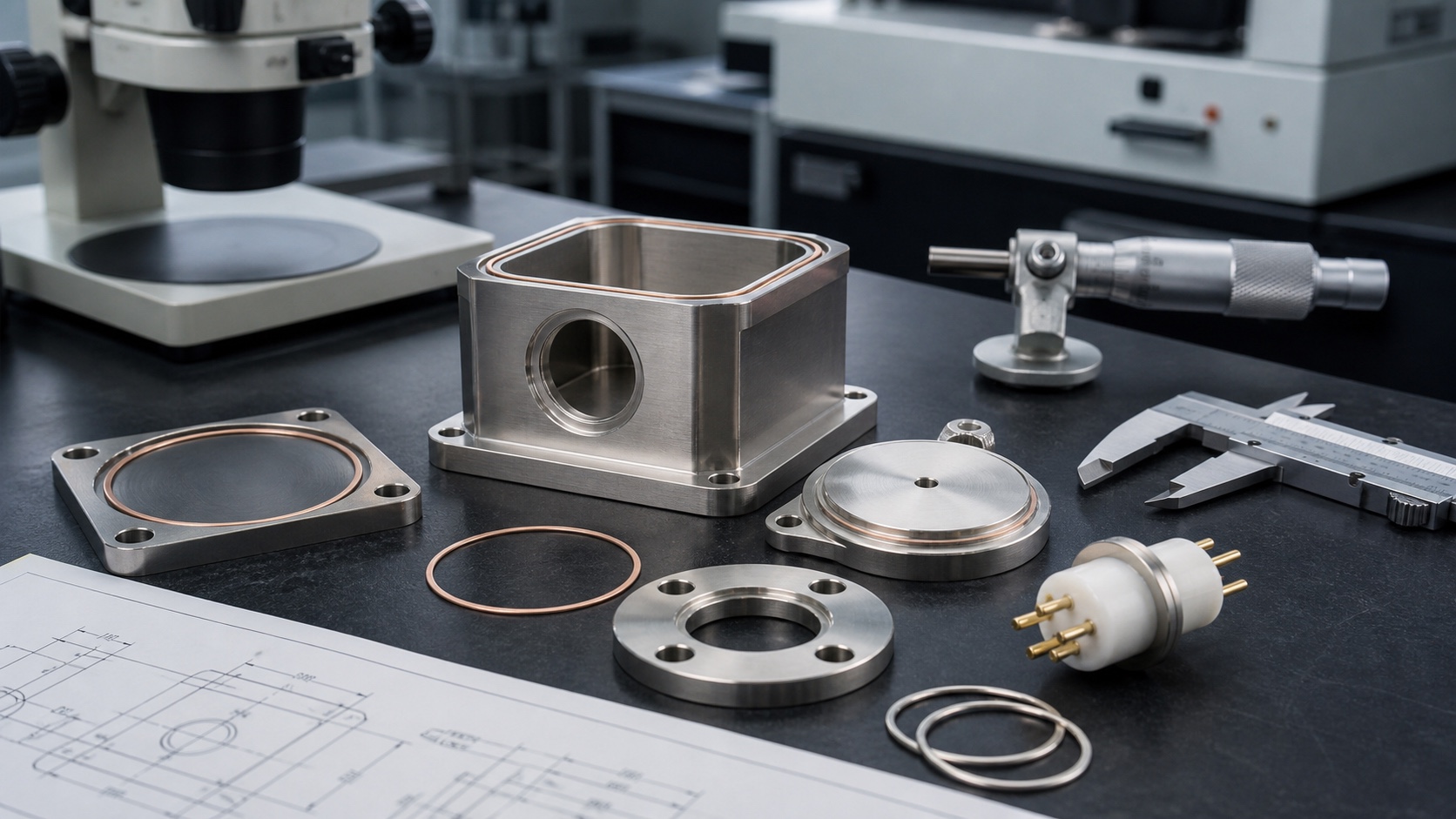
KELTRYN machines Kovar hardware used in these kinds of assemblies, including housings, lids, sealing rings, flanges, and precision frames. Joint geometry, surface finish, burr control, and dimensional stability should be defined with the customer's qualified downstream brazing process in mind.
Best Filler Metals for Brazing Kovar
Filler selection drives everything downstream: braze temperature, joint strength, thermal durability, and corrosion resistance. Here are the commonly considered filler families.
Silver-Based Filler Metals (BAg Series)
Silver-copper fillers are the default choice for most Kovar brazing. BAg-8 (72% Ag, 28% Cu) is a eutectic alloy that melts at a sharp 780°C. Its excellent flow and ductility make it ideal for hermetic seals. BAg-8A adds a small amount of lithium to improve wetting on stainless steel and Kovar oxide films. BAg-1 (45% Ag, 15% Cu, 16% Zn, 24% Cd) melts lower, around 607°C, which is useful for step-brazing or when the assembly contains temperature-sensitive components. Because it contains cadmium, many current processes instead evaluate cadmium-free filler options such as BAg-7 or BAg-24, subject to the required joint properties and applicable regulations.
BAg-8 and suitable lithium-bearing silver-copper fillers are common candidates for Kovar-to-Kovar or metallized ceramic joints. Final selection must account for atmosphere, counter-material, service temperature, and the filler supplier's qualified process window.
Gold-Based Filler Metals
When reliability requirements justify the cost, gold-based fillers are excellent. Gold-copper alloys, like Au-20Cu, melt around 890°C and offer outstanding corrosion resistance and ductility. Gold-nickel, such as Au-18Ni, melts near 950°C and is widely used in vacuum tube and electron-tube assemblies where outgassing must be minimal.
Gold fillers are often selected for corrosion resistance, low-vapor-pressure performance, and elevated-temperature strength. Their high cost generally limits them to applications whose qualification data and service conditions justify the choice.
Copper and Nickel-Based Fillers
Pure copper is a good high-temperature filler for Kovar, brazing at around 1083°C and higher, which suits services above 300°C or applications requiring multiple brazing cycles. Copper is inexpensive and electrically conductive, but its expansion is higher than Kovar's, so joint design must accommodate CTE mismatch stress.
Nickel-based fillers, the BNi series, offer the highest service temperatures — typically up to 800°C or more. BNi-2 (Ni-7Cr-3B-4.5Si-3Fe) melts between 970 and 1000°C and may be used for the first, higher-temperature joint in a stepped-brazing sequence, followed by a lower-temperature filler that does not remelt the first joint. The boron and silicon in BNi fillers act as melting-point depressants but can form brittle phases if the joint gap is too wide.
Active Brazing Fillers for Ceramic-Kovar Joints
When brazing Kovar directly to ceramics, active brazing alloys containing titanium are game-changers. These fillers, typically Ag-Cu-2Ti, contain a reactive element that chemically bonds with the ceramic surface — eliminating the need for prior metallization. The titanium reacts with the ceramic surface to form a thin reaction layer that enables wetting without a separate molybdenum-manganese metallization layer.
Patent literature on ceramic-Kovar sealing, including CN102350554A, describes how active brazing approaches simplify production by removing process steps. The trade-off is tighter process control and higher temperatures, but for many applications, direct active brazing is faster and more reliable than traditional metallization-then-braze routes.
Kovar Brazing Methods and Process Conditions
The method you choose affects joint quality, throughput, and cost. Here's how the four dominant processes compare.
Vacuum Brazing
Vacuum brazing is widely used for high-reliability Kovar assemblies. Vacuum in the 10⁻⁵ to 10⁻⁶ Torr range can greatly limit oxygen exposure and eliminate flux in appropriately qualified processes, while clean parts and a controlled preheat remain necessary to manage outgassing and trapped gases.
Typical vacuum cycles take Kovar parts through a slow preheat, ramp up to the braze temperature (often 800 to 950°C for silver-copper fillers), hold for a short soak, then cool under vacuum to minimize residual stress. The clean result is corrosion-resistant, reproducible joints with excellent capillary flow.
Hydrogen Furnace Brazing (Dry/Wet)
Hydrogen furnace brazing is the classic method for Kovar and glass-sealing alloys. Dry hydrogen, with a dew point below about −40°C, actively reduces metal oxides at temperature, allowing filler to wet bare metal surfaces. Some processes introduce wet hydrogen at specific stages to control oxide growth intentionally — particularly when preparing Kovar for glass sealing.
The controlling variable is dew point. Too wet, and you get stubborn oxides and poor wetting. Too dry, and certain alloying elements like manganese can be reduced out of the surface. In practice, the dew-point window should be qualified for each braze design and furnace system.
Induction Brazing
Induction brazing uses a high-frequency alternating field to heat the joint locally and rapidly. For small Kovar assemblies — feedthrough pins, connector bodies, tiny hermetic packages — induction brazing is fast and energy-efficient. It works well in air with flux or in a local inert-gas shroud.
The downside is thermal gradient. Kovar's low thermal conductivity means overheating near the coil is easy, which can cause distortion or overheating of nearby glass seals. Dwell times should be short, and filler metals with narrow melting ranges, like BAg-8, behave best.
Torch Brazing
Torch brazing of Kovar is possible, but it's the most demanding method. Because Kovar's oxides are tenacious, you need an aggressive flux — typically a borax-based or fluoride-containing formulation. Heating must be uniform and controlled, which is tricky for thin-walled parts or assemblies with ceramic components.
For low-volume repairs or prototype work, torch brazing with BAg-1 or BAg-24 and flux can produce acceptable joints. For production hermetic components, vacuum or hydrogen furnace brazing is generally more controllable than torch brazing.
Brazing Temperature and Cycle Selection
Most Kovar brazing happens between 700°C and 1000°C, depending on the filler. The braze temperature should typically be 30 to 100°C above the filler's liquidus to ensure fluid flow without excessive erosion of the base metal. Dwell times are short — usually 5 to 15 minutes at temperature — since Kovar is a poor thermal conductor and long holds increase diffusion and intermetallic growth.
Cooling rate matters enormously. Slow cooling reduces residual stress at ceramic interfaces and minimizes the risk of delayed cracking. For glass-sealed assemblies, controlled cooling through the glass transition region is essential to prevent stress fractures.
Brazing Kovar to Other Materials
Kovar rarely joins to itself alone. The most demanding applications involve dissimilar materials. Let's address each pairing.
Kovar-to-Kovar Brazing
Kovar-to-Kovar joints are the simplest case. Because both components share the same nominal CTE, dissimilar-material expansion mismatch is minimized, although fixture restraint, geometry, and the thermal cycle can still create stress. A compatible silver- or gold-based filler can produce a strong hermetic joint after process qualification. The main practical concerns are achieving clean surfaces and maintaining joint clearance during heating — Kovar's expansion can close or open gaps if the fixturing doesn't hold geometry.
For hermetic packages, BAg-8 with a 0.05 to 0.10 mm clearance produces predictable capillary flow and leak-free results. A small shoulder or step can establish positive joint location before the furnace cycle, subject to the assembly's capillary-flow and inspection requirements.
Brazing Kovar to Ceramics (Alumina, Silicon Carbide, Zirconia)
This is where engineering gets interesting. Alumina's CTE is close to but not identical to Kovar's, and silicon carbide or zirconia present even larger mismatches. Two routes exist: indirect brazing with metallization, or direct active brazing.
The Mo-Mn metallization process coats the ceramic surface with a molybdenum-manganese paste that fuses into a glassy bond layer during a high-temperature firing step. The metallized ceramic is then nickel-plated and brazed conventionally with silver or gold fillers. This approach is highly reliable but adds process steps and cost.
Active brazing, as discussed, uses Ag-Cu-Ti fillers to bond directly to the ceramic. It's faster, but CTE mismatch must be managed with ductile fillers or compliant interlayers. Patents such as CN102350554A describe optimized ceramic-Kovar sealing processes that emphasize interlayer design and controlled cooling to dissipate thermal stress.
Brazing Kovar to Glass (Glass-to-Metal Seals)
Direct glass-to-metal sealing traditionally relies on a controlled oxide layer on the Kovar surface. The oxide — typically iron and cobalt spinels — is wetted by molten glass, producing a graded, stress-resistant seal. This is a specialized art involving dew-point-controlled hydrogen firing.
Sometimes brazing is preferred over direct sealing, particularly for precision assemblies where glass flow cannot be controlled accurately or where a metal intermediate ring is needed. In those cases, glass is first metallized or coated, then brazed to Kovar with a low-temperature filler. Brazed glass-to-Kovar joints can be more forgiving than direct seals because the braze alloy absorbs some thermal strain.
Brazing Kovar to Stainless Steel or Other Metals
Kovar is often brazed to stainless steel flanges or copper leads. Silver-copper fillers work well for both. The main risks are galvanic corrosion in humid service conditions and the formation of brittle intermetallics when joining to copper or aluminum.
When brazing Kovar to stainless steel, gold-nickel fillers reduce oxidation concerns and produce high-strength joints, though at higher cost. For Kovar-to-copper, keep joint gaps on the tighter side — around 0.05 mm — to control the diffusion zone and avoid copper embrittlement.
Step-by-Step Kovar Brazing Procedure
A reliable Kovar braze depends on a repeatable, validated process. The following sequence is a general starting framework.
Surface Preparation and Cleaning
Surface preparation is non-negotiable. Machined Kovar parts arrive with cutting oils, chips, and tenacious oxides. Start with a validated solvent or alkaline degreasing process, followed when required by a material-compatible oxide-removal procedure. Chemical cleaning must follow the chemical supplier's instructions and the facility's qualified environmental, health, and safety controls. Rinse and dry using the validated process before assembly.
After cleaning, handle parts with gloves or clean tweezers. Any fingerprint leaves enough organic residue to cause poor wetting or sooty joints in vacuum brazing.
Joint Design and Clearance
Capillary action drives braze flow, and capillary action depends on gap. For silver-based fillers, the optimal clearance is 0.05 to 0.12 mm (0.002 to 0.005 in). Lap joints are preferred over butt joints because they provide a longer sealing path and better mechanical strength. For hermetic applications, a lap length of three to five times the thin-wall thickness is a sensible starting point.
Remember that Kovar and the mating material will expand differently during heating. The room-temperature gap should be designed so the hot gap lands in the optimum range at brazing temperature.
Fixturing and Assembly
Fixtures must hold components at the correct position without restricting free thermal expansion. Graphite, alumina, and Kovar itself are all suitable fixture materials. Graphite is a good choice because it has low CTE and doesn't weld to the assembly, but it can carburize the surface if braze filler contacts it.
For small parts, gravity placement often suffices for lap joints. For vertical joints, spring-loaded clips made of Inconel or molybdenum keep parts in contact while accommodating movement.
Brazing Cycle Execution
The furnace cycle begins with a purge or evacuation to the target atmosphere. Ramp rates should be controlled — generally 10 to 20°C per minute up to a preheat plateau below the filler solidus, allowing temperature to equalize. Then heat rapidly to the braze temperature, hold for the required soak, and cool slowly, typically 5 to 15°C per minute, until the filler solidifies.
The most common mistake is cooling too fast. Kovar's low thermal conductivity holds heat in joint areas, and thermal gradients can distort thin-wall components or crack glass seals.
Post-Brazing Inspection and Quality Control
After brazing, verify joint integrity before anything else. Helium leak testing is the gold standard for hermetic components. X-ray inspection reveals voids, fill gaps, and filler distribution. Metallographic cross-sectioning — performed on a sampling basis — shows whether the interlayer microstructure contains brittle phases or was consumed by base-metal erosion.
Upstream machining can reduce downstream variables by controlling burrs, sealing features, dimensional consistency, surface condition, and material traceability. The brazing and inspection plan itself should remain under the control of the qualified joining facility and the customer's quality requirements.
Common Kovar Brazing Challenges and How to Solve Them
Even experienced shops hit defects. Here's how to diagnose and fix the most common ones.
Oxide Formation and "Pink" Discoloration
Kovar parts sometimes come out of brazing with a pink or rose-colored tint. This "pink oxide" is actually a copper-colored cuprous oxide layer, formed when oxygen is present during cooling. It's a cosmetic defect in mild cases, but it indicates that the atmosphere leaked or the dew point was too high.
The fix is preventive: maintain proper vacuum integrity, monitor furnace leak rates, and keep hydrogen dew points in the specified window. If pink oxide appears, it can often be removed with a light acid pickle, but re-brazing contaminated surfaces will only compound the problem.
CTE Mismatch and Cracking in Dissimilar Joints
Cracks appear near ceramic or glass interfaces when thermal stress exceeds the material's strength. Solutions include using ductile silver fillers that plastically deform and absorb strain, adding a soft copper or nickel interlayer foil, and slowing the cooling rate. Redesigning the joint to shorten the length of rigid interface also helps by lowering the total accumulated strain.
Poor Wetting and Filler Flow
If the filler balls up instead of flowing, the surface wasn't prepared correctly. Check cleaning procedures, atmosphere purity, and temperature profile. Also verify the joint gap — if it's too wide, capillary forces are too weak to draw filler through the joint. A gap above 0.15 mm will frequently produce incomplete fillets.
Porosity and Voids in the Braze Joint
Voids are usually caused by trapped gas, outgassing from the base metal or contaminants, or filler oxidation. Ensure the filler metal is clean and dry, extend the preheat step to allow outgassing, and check whether the vacuum level is adequate. In some cases, swapping to a filler with better de-oxidizing elements, like BAg-8A, eliminates the problem.
Controlling the Interlayer Microstructure
Academic studies on ceramic-Kovar interfaces — published in journals like ScienceDirect and Springer — show that melting and cooling rates control the thickness and distribution of intermetallic phases at the interface. Rapid cooling freezes in brittle phases; slow cooling allows beneficial diffusion. For active-brazed joints, microstructural control is central to thermal-cycle reliability and should be demonstrated with application-specific qualification data.
Brazing vs. Other Kovar Joining Methods
Brazing vs. Welding Kovar
Kovar can be welded, but it's not a forgiving material. Its high nickel and cobalt content makes it susceptible to hot cracking under concentrated heat input, especially if the weld pool is contaminated. Welded Kovar assemblies also concentrate stress at the weld line, which expands and contracts during thermal cycling in ways that crack glass or ceramic seals.
Brazing, by contrast, heats the entire joint area uniformly and produces a ductile, stress-absorbing interface. For thin sections, hermetic seals, and ceramic-coupled assemblies, brazing is often favored, but welding may still be appropriate when its procedure and acceptance criteria are qualified for the design.
Brazing vs. Soldering Kovar
Soldering works at temperatures below 450°C and is ideal for attaching Kovar leads to printed circuit boards. But soft solder joints are weak — typically 20 to 40 MPa shear — and cannot tolerate high temperatures, high vacuum, or corrosive environments.
Brazing produces joints that are stronger, more vacuum-tight, and serviceable at several hundred degrees Celsius. If your assembly must survive bakeout, thermal cycling, or mechanical load, you need brazing, not soldering.
Brazing vs. Glass Sealing and Adhesive Bonding
Direct glass sealing is a brilliant process when you need a graded, stress-free transition between Kovar and glass — and it's essential for many classic hermetic feedthroughs. But it requires tight oxide control and specialized furnace capacity. Brazing gives you more design freedom because you can join Kovar to pre-manufactured glass, ceramic, or metal components with a wider tolerance on materials.
Adhesive bonding can be fast and economical, but many adhesives are unsuitable for hermetic, high-temperature, or vacuum-rated applications unless specifically qualified for those conditions. Brazing remains a common high-reliability option.
Frequently Asked Questions About Brazing Kovar
Can Kovar be brazed to copper?
Yes. Kovar brazes cleanly to copper using silver-based fillers like BAg-8 or gold-based fillers when corrosion resistance matters. The main concern is CTE mismatch — copper expands roughly three times more than Kovar. Use a lap joint with a tight, controlled gap around 0.05 mm, and be prepared for some residual stress at the interface.
What temperature do you braze Kovar?
It depends entirely on the filler. BAg-1 brazes around 620 to 650°C. BAg-8 needs 780 to 800°C. Copper and gold-nickel fillers run up to 1000°C or higher. Select the temperature based on your required service conditions and any temperature-sensitive components in the assembly.
Does Kovar need flux when brazing?
Only for torch or air brazing. In vacuum or hydrogen furnace brazing, no flux is needed — the atmosphere itself controls oxidation. For torch brazing, use an active borax- or fluoride-based flux and apply fresh flux just before heating for the best results.
Can Kovar be welded?
Yes, Kovar can be welded using TIG, electron beam, or laser welding. However, it's prone to cracking if heat input is uncontrolled, primarily because of its high alloy content and hot-tear susceptibility. For thin walls, hermetic seals, and mixed-material joints, brazing is the safer, preferred process.
What is the best brazing filler for Kovar glass-to-metal seals?
Silver-copper eutectic, BAg-8, is the most common choice due to its excellent wetting, ductility, and moderate melting point. Gold-copper fillers are preferred for ultra-high vacuum and corrosive service. Both can be compatible with properly prepared Kovar, but the filler and surface condition must be qualified for the specific glass, metallization, atmosphere, and service environment.
Conclusion
Brazing is not just possible on Kovar — it's the most reliable joining method for this alloy, provided you manage oxides, select the right filler, and control the thermal cycle. Whether you're sealing Kovar to alumina for an aerospace feedthrough, joining Kovar to glass for a laser package, or brazing Kovar-to-Kovar for a hermetic housing, the principles are the same: clean surfaces, controlled atmosphere, matched filler, and disciplined cooling.
KELTRYN precision-machines custom Kovar housings, lids, caps, sealing rings, flanges, frames, and other Fe-Ni-Co alloy components for hermetic and high-reliability applications. From prototypes through repeat production, the team supports manufacturability feedback, material traceability, burr control, and dimensional inspection. If you are defining a Kovar component for a qualified brazing or sealing process, share the drawing, material specification, mating parts, and critical sealing features so the machining requirements can be reviewed before production.